Want to film or take professional pics at Port City? Make a payment to bank of China

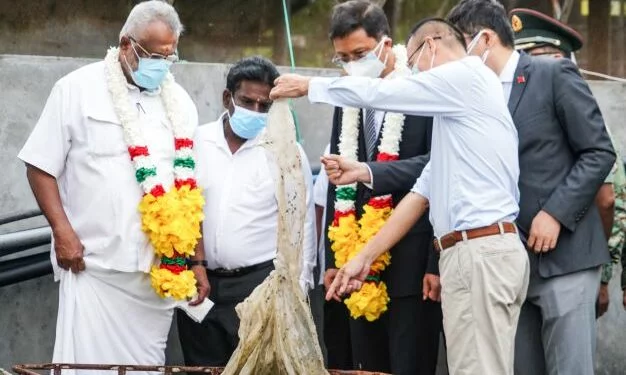
Port City Colombo, which recently opened its public gallery to visitors, yesterday said that it had been forced to introduce payment methods for those willing to shoot professional pictures and videos on the Port City premises due to a rising number of requests from social media users and companies who wished to make an income from filming on the premises, the Daily Mirror learns.

A payment sheet introduced by Port City Colombo was highly shared on social media yesterday, which stated that if people wished to take professional pictures and videos for personal use, a payment ranging between Rs.30,000 to Rs.50,000 would have to be made.

According to the payment sheet for ‘personal’, if the shoot involved 2 to 5 people for one to three hours, a sum of Rs.30,000 would be charged and if there were 6 to 10 people, for the same duration of time then the sum would be Rs.50,000.
If there were more than 10 people involved in the project for the same period of time, then the payment was listed as ‘variable’.
For commercial purposes, if there are less than 10 people involved in the photo or video shoot for the same duration of time, a sum of Rs.100,000 would be charged. And if there are more than 10 people for the same time period, the sum charged was listed as ‘variable’.

Head of PR at CHEC Port City Colombo Pvt. Limited, Kassapa Senarath confirmed to Daily Mirror the authenticity of the payment schedule and said this however did not apply to those who wished to take selfies, pose for pics or video at the public viewing area when they visit the gallery.

He said when the public gallery of the Port City Colombo initially opened its doors recently, there were many social media users, musicians and even companies who visited the premises bringing in professional camera equipment to shoot for their products and videos. Some social media users had also come under the pretext of it being a promotion for the newly opened Port City premises.
However Kassapa clarified that this was a hindrance to the workers on site as the Port City was still a construction site and the safety of the people had to be maintained while all health guidelines also had to be strictly followed.

“Some people even came with heavy equipment which is why we then decided that if anyone needs to use the premises for their professional work and earn an income, then a fee will be charged. It is not done to earn any profit but done to maintain the protocols and health guidelines as the Port City is still a construction site. It is a general pricing structure,” Kassapa said.

The payment chart shared on social media received flak from the public and some even criticized as to why the payment had to be made to the Bank of China.

Kassapa said this was because the Port City maintained an account with the local branch of the Bank of China.

Taking forward the India ties, one more time?

It was a virtual meeting of ‘un-equals’ or ‘non-equals’, but that also brought out the brother/sister relations between the two, where diplomatic protocol had not much of a place. Between them, Sri Lanka’s Finance Minister (FM) Basil Rajapaksa and India’s External Affairs Minister (EAM) S Jaishankar have sought to remove the cobwebs in bilateral relations to a desired level.

The choice of the FM on the one side and the EAM on the other side showed their respective priorities. For Sri Lanka, the economy, finances and forex is of immediate concern. For India, strategic security, this one centred on Sri Lanka, is a near-eternal cause for concern.

In the last round, when FM Basil went to Delhi a few weeks back, India presented a unique pair for the interaction. His counterpart Nirmala Sitharaman joined EAM Jaishankar in one of the two interactions between the Finance Ministers. This time for the virtual meeting, Sri Lanka did not seem to have suggested to upgrade their own team by including Foreign Minister G L Peiris. Or, so it seems.

India has a unique 2+2 discussion format involving their Foreign and Defence Ministers, in the case of the US first and Russia too in the recent past. Given mutual interests, concerns and expectations, a uniquely-suited 3+3 format would suit India and Sri Lanka even better, where respective Defence, Foreign and Finance Ministers huddle together for an annual, if not bi-annual or quarterly, exchange of ideas so as to facilitate early decision-making on either side.

Maybe, the respective Defence Minister’s place can be taken by the National Security Advisor (NSA), or it can be made a grand foursome group from either side. In Sri Lanka, most definitely, there would then be a protocol issue when it comes to identifying the team leader, but these are issues that governments by now should have been matured enough to resolve internally – if such a decision is taken.

For sure, such a scheme should be unlike the ad hoc arrangement that the Mahinda Rajapaksa regime put in place at the height of the ethnic war more than a decade back. This should be a more formal, institutionalised arrangement, whose life and term is not coterminous with either elected government leadership in power in the two capitals.

Tall on promises, but… the taste of the pudding is but then in the eating. Independent of the party or leadership in power in Colombo, India has always found Sri Lanka being tall on promises but short on implementation. Rather, a stark unwillingness has been seen all along, as if the government of the day did not at all intend sticking to the commitment.

New Delhi has always been left with the feeling that the Colombo leadership of the day was looking either for an economic succour of the current kind – which of course is the worst in a series – or political support as at UNHRC, or just moral support to face off electoral rivals nearer home, as in the case of former UNP Prime Minister Ranil Wickremesinghe. Whether promising a fair deal to the Tamils or unilaterally declaring to throw out China from the proposed Colombo Port City (CPC) project, if elected to power (whether or not sought by India in public or private), Ranil was very, very tall on promises. When it came to implementation, they did precisely what the Rajapaklsas did, but with greater elan and sophistication.

Either way, for India, the results were the same, not that New Delhi wanted China firmly out of CPC even before the first sod of land has been turned on. Ranil made it look like but his party and the breakaway SJB since have both declared that they are all for CPC, but were only opposed to the incumbent Gota Rajapaksa presidency’s legal scheme for the management of the Port City.

It was the same when it came to Ranil’s anticipated slow down on the China-funded Hambantota Port project. His decision to hand over Sri Lankan territory to China, purportedly on a 99-year-lease even when the rival Rajapaksas ‘stoutly’ (?) opposed the conversion of their construction-cum-concession contract into the new arrangement exposed the UNP for what it was worth.

The real debt and debt-trap are here, which the Rajapaksas did not possibly expect to be caught resolving when they took all those big-loans, especially from China with its usurious ways of money-lending. Possibly, they had hoped that the Opposition would continue to be in power for two or three terms, going by past national records and electoral history. That did not happen and they are now back in power, earlier than expected and earlier than they too may have wanted, barring as a check against personal harassment of their clan members by the previous regime.

Ranil’s charge of a debt-trap created by the Rajapaksas while in power before him was the cause was such conversion, as he wanted the world to believe, he poked a hole in his own argument by going back to China for more big-ticket loans for projects like highways construction that could well have waited. What is good for Ranil is equally so in the case of the SJB. This has left India with little option in dealing with Sri Lanka. Favourably, the Sri Lankans could call their stubbornness, ‘national consensus’.

Seeds of mistrust

While referring to the previous week’s $ 900-m package, EAM Jaishankar had tweeted about hopes of progress in the $ 1.5-b aid sought by Sri Lanka, which he had discussed with FM Basil on Saturday, 15 January. The tweet quoted FM Basil as mentioning various manufacturing sector heads as possible areas for Indian investments.

It is here the ECT-like hiccups and change-of-minds could occur, recur. Sri Lanka need not fool itself that India was mighty pleased with the offer of WCT in Colombo Port in the place of ECT, citing labour protests. New Delhi has seen enough of the world and even more of Colombo to be fooled. It is this kind of Colombo’s conduct that sows seeds of mistrust even in the average Indian mind.

In the past, Sri Lanka has only given cause for the mistrust to grow with each passing instance, each passing economic agreement or political understanding. The post-war shifting of political goal-post on a political settlement to the ethnic war was the irking element that caused New Delhi to side with the US at Geneva, circa 2012. Or, so it seems.

Against this, Jaishankar’s tweet has said that India would help find aid-partners for Sri Lanka. Clearly, it is other than China, and obviously aimed at discouraging Sri Lanka from going the China way, the Hambantota way, all over again. The assumption is that Colombo is agreeable to the idea, though throughout the Rajpaaksas’ administrative career, they have kept out the West and the IMF, whom they consider as an ‘American stooge’.

This will be an interesting phase to watch for all Sri Lankans. So would be the coming weeks, the run-up to the Geneva session of the UNHRC, where Sri Lanka would again be put over the coals. India to an extent can influence global decision, yes, but if and only if Sri Lanka ensures that the Tamils get their due (after the TNA had hardened their stand on 13-Plus, using a letter to Indian Prime Minister Narendra Modi as a ploy).

India should also be satisfied to convince the ‘international community’ (West) that their collective strategic concerns over China are a thing of the past. This is independent of Chinese Ambassador Qi Zhenghong’s Jaffna escapades, followed by his Foreign Minister Wang Yi’s Colombo visit, which have raised more questions about Sri Lankan collaboration than China’s intentions and provocations.

That Indian High Commissioner Gopal Boglay thought it necessary to rush to New Delhi on what could be described as an unscheduled visit, only to fast-track the $ 900-m deal and also put the subsequent $ 1.5-b arrangement in place, should be proof of India’s concern in rushing to Sri Lanka’s help as a good neighbour and relation. A lot will now depend on how far Colombo goes to discourage anti-India elements purportedly opposed to the Trinco oil tanks farms deal -– if it came anywhere close to the efforts it put in neutralising anti-lease protests in the case of Hambantota. Or, will it be akin to the way the government used street-protests to stall CEPA as far back 2008, or the ECT deal more recently, is the million dollar question.

As Sri Lankan High Commissioner Milinda Moragoda even recently told a New Delhi media interviewer, the two nations had to move away from this ‘transactional phase’ to be able to look at the bigger picture. That is where the hitch may still be. Colombo’s problems with New Delhi vide collaborated projects may only be procedural, alleged delays in particular. That’s not the case with India’s concerns about Sri Lanka. There is an anticipated air of uncertainty and insincerity from the very start – and at the instance of, or to please a ‘third party’ – of course, China, in this post-Cold War era!

Posted in Uncategorized

Sri Lanka’s fresh equidistant policy vis-à-vis India and China

The dollar-starved Sri Lankan government is buoyed that it has been receiving financial assistance from India and China, which are vying for the dominance of the South Asian part of the Indo-Pacific region.

In recent weeks, regular announcements that the country has received currency swaps and credit lines from both these countries indicate, on the one hand, a temporary equilibrium or truce in the Indo-China power rivalry over Sri Lanka and, on the other, a foreign policy course correction by the Gotabaya Rajapaksa government.

It was not for nothing that President Rajapaksa in his policy statement on Tuesday included a short paragraph with a geopolitical undertone. It said: “We are a free sovereign nation. We have no need to intervene in conflicts among powerful nations. While we respect our neighbours, we wish to pursue a policy of friendship with all States.”

Such a declaration of neutrality was also found in the President’s inauguration speech in November 2019. But in practice there had been an apparent tilt towards Beijing in the government’s policy, much to the chagrin of New Delhi until the pandemic and the fast depleting foreign currency reserves brought upon the realization that it would be in Sri Lanka’s interest to always maintain foreign policy neutrality vis-à-vis the regional power conflict between India and China.

The apparent course correction is bringing in some early returns, with India and China coming forward to help Sri Lanka to tide over what could be its worst economic crisis in its 74-year post-independence existence. However, to think that such assistance is not conditions-attached is political naivety. Beijing’s assistance, especially in the afterglow of its foreign minister’s visit to Sri Lanka and similar help from New Delhi after Sri Lanka’s finance minister’s political angioplasty in the artery to the heart of India give the impression that the two Asian powers have decided to put up with Sri Lanka’s fresh equidistant policy assurance.

In the horn of Africa, strategically placed port nation of Djibouti has gone to the extreme with its equidistant foreign policy. The country of one million people with a US$ 3billion GDP, which is equivalent to China’s GDP for two hours, has allowed China’s People’s Liberation Army to set up its first overseas military base—and that, too, just 10 kilometres away from a US military base. The country also houses French, German, British, Italian, Spanish Saudi Arabian military facilities. Russia and India are also seeking a military presence in the country that overlooks one of the world’s busiest sea lanes — the Bab al Mandeb chokepoint that connects Red Sea with the Gulf of Aden.

Sri Lanka need not and, we hope, will not go to the extent of emulating Djibouti to swell its foreign reserves. The country’s equidistant big-power policy should remain demilitarised without ambiguity. This is a difficult task for the government, given the big powers’ ability to turn their demilitarised presence into militarised presence if the need arises. Greece, for instance, despite being a Nato member, is compelled to permit visits by China’s naval vessels to its ports developed with Chinese financial assistance.

Unlike the Cold War conflict which saw rival powers not only severing diplomatic ties but also economic ties, the present day subterranean cold war, which is also referred to as hybrid warfare, allows trade relations between hostile powers to flourish even as military hostilities escalate amid mutual suspicion, sabotage of rival nation’s geostrategic projects and influence buying with neighbours.

A textbook case of this hybrid warfare is Sino-India relations. While the COVID pandemic was raging across the world in mid-2020 and India was struggling to cope with it, Chinese troops crossed the Line of Actual Control and captured 1000 square kilometers in eastern Ladakh. About 20 Indian soldiers died in the unexpected attack. In the northern most Indian state of Sikkim, a tense situation arose following Chinese military incursions in January and May last year. While Beijng was testing India’s resolve to take on China militarily, the two countries are also focused on undermining each other’s geostrategic footholds in neighbouring nations. This was while trade between India and China reached a record $125 billion in 2021.
Perhaps with the exception of Pakistan, every South Asian nation has caught up in the Sino-India hybrid war. Take for instance, the case of the Maldives.

China’s foreign minister Wang Yi, ahead of his recent visit to Colombo, was in the Maldives, a country which under President Ibrahim Solih, has embraced an India-first policy to amend relations that remained strained during the presidency of pro-China Abdulla Yameen. But of late, President Solih has been seen adopting an equidistant foreign policy vis-à-vis China and India. Last year, the capital, Male, also saw a series of public protests against India’s alleged military presence in the archipelago. The government said the protests were the handiwork of Yameen supporters, who deliberately misinterpreted the positioning of a few emergency-response Indian helicopters in a Maldivian atoll as unsolicited Indian military presence. However, in small countries like Sri Lanka, the Maldives and Nepal, it is strongly suspected that rival big powers play a behind-the-scenes role in instigating public protests and getting involved in regime change ops.

Writing for the Indo-Pacific Defence Forum magazine, Sarosh Bana, executive editor of Business India, says India must continue to counter China’s attempts to buy influence with its neighbours.

In addition to offering neighbours economic and military alternatives to China’s One-Belt-One-Road enticements, India should look to the Quad, he said, adding that together, the Quad nations – India, the United States, Japan and Australia — could create an infrastructure fund that provides financially sustainable alternatives to China’s debt-trap projects for India’s neighbours.

But China rejects allegations that it is setting debt traps for developing nations with predatory loans often extended to financially unsustainable infrastructure projects with the intention of taking over the facilities after defaults on repayments.

China also vehemently rejects recent reports that it is planning to take over the Entebbe airport after the Ugandan government had defaulted repayments of the loan it obtained from China’s Exim Bank. But the Wall Street Journal which first published the story and Ugandan opposition figures say the terms of the takeover are in the fine print of the US$200 million agreement, which was not revealed to the public by the Ugandan government.

Whether the allegations are credible or not, loan-obtaining small countries should be mindful that there is always a hidden price attached even in free aid, for there is no free lunch in international politics. Whether this price is worth paying for is a matter to be prudently assessed by policy makers and advisers.

Sri Lanka should be prudent enough to balance its short-term and long-term national interest with the national interest of those big powers which seek to increase their strategic foothold in Sri Lanka by offering assistance Sri Lanka desperately needs.

The Begging Bowl Sri Lanka’s Dependency Syndrome

The sheer dearth of dollars to pay off debts, buy oil and the poor performance in the export sector together with slackness in the traditional exports like tea, rubber and coconut are contributing to aggravate the economic crisis and monetary management

As a country and a nation, we are becoming the scum of Asia, not its miracle as some bellowed from roof-tops and election platforms sometime back, as well as a country at loggerheads with itself with an array of problems and issues still at bay in need of effective solutions that are urgent. The debt-ridden wound has certainly festered through the decades of the post-independence Sri Lanka and appears to get worse as our foreign reserves dwindle, exports crumble, imports in high demand and national assets sacrificed to distant dreams, the success of which time only can tell after generations would have passed through economic insecurity and social unrest with nationhood in disarray and sovereignty at a terribly risky edge.

We are against the wall as far as the national economy is concerned. There is an acute disagreement among the theories and opinions expressed regarding the most effective way out of a mess that is the sheer result of contentious politics and pitifully sad economic planning by the so-called pundits who are vociferously coming into defending their much short-sighted positions and viewpoints. Some claim that we on our own can man this moment and contain the crisis while others ardently plead for currency swaps, assistance from neighbouring countries or take refuge in a desperate appeal to the IMF. The top-notch from the BOC expresses great concern and anxiety over the adverse effects that the country would have inevitably to face, if recourse is had to assistance from the IMF taking into consideration the conditions that have to be submitted to. Among them a few disturbing elements have been mentioned: the risk of having to pay 20% more for oil purchases, having to privatize the BOC, freeze public salaries and prune the public service, diversify the government pension scheme, privatize all SOEs and many more adverse demands. Defence is placed on the fact of foreign reserves being on the increase to over US $ 3 billion which will assist in tackling this year’s debt servicing. Many seem to have put to the oblivion the bitter truth that the same foreign reserves had plummeted from US $ 8 billion two years ago to just US $ 1 billion in December 2021. We are stuck with having to contend with an annual import bill of US $ 18 billion while exports stagger around only US $ 11 billion. This is an incredibly paradoxical situation.

The recent fertilizer crisis upset the apple cart for our poor farmers who daily began to revolt and take to the streets to bemoan their predicament with their cultivation efforts threatened by the sudden change of fertilizer policy. They even threatened to halt cultivation. Rice and vegetables were in great want and the prices began sky-rocketing. It is a shame that with such rich soil in the country, this once granary of the East along the silk-route is being put under pressure to import these food items from neighbouring countries. It is a disgrace to our forefathers and valiant ancestors of old who bequeathed to us this rich rice-culture. The question is seriously posed as to who is responsible for this mafia that is inducing hunger in the country. Who are the king-pins behind this catastrophe who have cashed in their commissions in millions at the expense of bringing untold suffering and anxiety to the farmers who have to toil so hard to get a fair price for their produce? If as is assured that foreign reserves have arisen why is the release of dollars not possible. There are unfortunate reports of so many containers lying stuck in the harbour with medicines and food-stuffs waiting to be released. Apparently, the lack of dollars is causing delay in this matter. Complaints are umpteen that there are some ministers who are utterly incompetent, inefficient and making wrong decisions that is causing lot of harm in the smooth running of the government. There is a popular cry that they be relieved of their responsibilities and competent men appointed for their seats instead. There is as the President recently and sadly observed a lack of confidence in the way things are being run by the government. The pandemic debacle is no panacea excuse for the downturn in many of the spheres of national life like international trade, agriculture and dwindling of exports. The sudden change of policy that overturned the fertilizer issue which some expert remarked had been done with ill advice as well, without a phasing out of this change, had been the root cause of crisis in the rice and vegetable shortage that soared its price to a sky-rocketing level ill affordable to the general public. The mishandling of the gas question created havoc in the kitchens. Some had even switched on to kerosene which also began to be in short supply as the queues demonstrated and worse with some taking recourse in firewood particularly in the interior and distant villages. The sad spectacle of long lines of utterly desperate crowds queuing up for gas and kerosene as well as the frantic chase to the marketing centres for food-stuffs ignited in many, loud cries of criticism, frustration, sheer anger, displeasure and despair.

Whether the country succeed in creating a programme of its own without recourse to foreign aid to tide over the financial crisis at hand is the million-dollar question anxiously raised by many a knowledgeable economist. On the other hand, the state of national politics is in utter confusion with many politicians calling on all parties, whatever their hue, to come together to find a way out of the present morass. All pledges on which the last elections, presidential and parliamentary were fought have not yielded tangible results that affect particularly the rural population. The cries of the farmer, the small-business holder and the daily wage earner are being heard loud and clear in the ears of the government. Unfortunately, difficult and unpleasant decisions may have to be taken but not at the cost of hurting people’s basic needs for food and health care. There seems to be a multi-faceted mafia intruding into the field of drugs and medicines as well in addition to the inability to clear the cargo containers that lie stagnant in the harbour. It is paradoxical indeed that the parliament has been prorogued while burning issues are affecting the country with the concurrent sense of insecurity, hopelessness and anxiety crippling the general public. Excuses and apologies are not the way out to respond to these clamors of the people. The national situation is really bad and viable means taken to tide over the mounting plethora of crisis are be sought with a compelling sense of urgency. This is the hour to act swiftly lest the whole country caves into misery, inflation and bankruptcy.
The story of the national debt that kept on accumulating in all directions with the need to run to international funding agencies such as the IMF and World Bank has now taken the country to another disastrous and highly questionable road of dealing with national assets like the harbours, cities, airports and oil tanks. The sheer dearth of dollars to pay off debts, buy oil and the poor performance in the export sector together with slackness in the traditional exports like tea, rubber and coconut are contributing to aggravate the economic crisis and monetary management. Urgent steps have to be taken to consolidate the tourist, apparel and textile industries. State expenditure has to be cut down to a minimum. It is imperative that many unnecessary functions have to be cancelled. Austerity must be shown in the life of those in government with humble readiness to make sacrifices on behalf of the people thanks to whom they are in seats of power. Bribery and corruption, waste and embecillment of funds have no place in a decently managed economy. The root cause of the present serious crisis has to be placed squarely with a government that is not handling national issues in a proper manner. Those at the helm seem inadequately prepared to come up with viable solutions. Alternatives seem very meagre and not forthcoming. The government is clearly bereft of alternatives. Blaming the opposition for criticizing the government and not offering any alternative implicitly shows that those in power are bereft of solutions and are completely lost in the situation which they as a government are morally obliged to face and take head on as quickly as possible without further delay.

Honest and sincere statesmen-like politicians do not pursue power at any cost, including the duping and the drugging of the masses making thereby elections the opium of the people, whilst hiding the truth about matters that are still highly controversial and contentious. Instead, using their people-given authority to rule in justice and fairness they must seriously have short and long-term plans for the economic stability, national integration and ethnic harmony, taking good care never to exploit religion, race, ethnicity and language to their own selfish and introverted advantage, ensuring equal treatment to all and in particular see to the immense sufferings and hardships of those who are poor and indigent. Then only can we see an about-turn of the country towards a better and permanently prosperous era. Bad politics and inefficient administration can never ensure stability in the economy. It is time that we empower ourselves to jettison the begging bowl and enter a culture of self-sufficiency and self-respect as a nation. The Taprobane must stay stable and strong: this island-paradise gracing the vast Indian ocean.

Posted in Uncategorized

Sri Lanka’s foreign policy: Clash of ideology and realpolitik

Historically, Sri Lanka’s relations with the world were driven by a number of factors. The country shifted from one position to another, allying itself with different interests at different points. While policy was largely shaped by the tenets of nonalignment, this did not preclude it from seeking friendships that went beyond such imperatives. Indeed, whenever it needed help, the government of the day turned to everyone it could turn to. More often than not it got the support it wanted, and made good use of it.

Foreign policy thrived under the first three SLFP administrations (1956-1959, 1960-1965, and 1970-1977) and became unwieldy under the first three UNP administrations (1948-1956, 1965-1970, and 1977-1989). This is not to say that all was well under the SLFP and all was bad under the UNP. But on a balanced note, the SLFP tried to implement a more consistent and far-reaching set of policies, an endeavour it largely succeeded in.

The UNP, on the other hand, tended to define itself in relation to British economic domination of the country, particularly in the plantations. This compelled it to privilege continuity over change. Thus, in the same period, it antagonised China, India, and Russia, confident that Whitehall and Washington would come to its assistance.

When that did not materialise and after it was routed at the polls, it began formulating foreign policy negatively, in opposition to whatever position the SLFP held; to give one example, from its initial position of hostility to India, the UNP sided with our neighbour to the north after Sirimavo Bandaranaike involved herself in the Sino-Indian War.

Arguably the most tumultuous period for our foreign relations was the J. R. Jayewardene administration. Turning away from its brief truce with India, Jayewardene’s UNP went on to antagonise that country, hoping that its alignment with the West would compensate for the loss of what was clearly a crucial friendship. Here too the underlying principle seems to have been one of opposition to the SLFP’s stance: since the Bandaranaike government had got so close to India, the UNP saw nothing wrong in alienating it.

Jayewardene’s biographers, K. M. de Silva and Howard Wriggins, have attempted to pin the blame for what followed on the machinations of Indian intelligence services and South Indian politicians. But their version of events ignores the UNP regime’s actions, including its abandonment of the tenets of nonalignment and its mess-up in the 1983 riots. It also fails to give sufficient weight to the fact that Indian intelligence ramped up support for Tamil militants after those riots, and that by reducing the country’s presence at the Non-Aligned Movement, the UNP exposed it to the pressures of regional power rivalries.

Different scholars give different explanations as to why the UNP behaved the way it did over the country’s external relations. Many of them agree that its policies were less successful than the SLFP’s, but almost all of them suggest that this was because of factors outside the party’s control. For instance, one scholar, quoting Jayewardene, contends that the country opposed the Soviet Union because the Soviet Union vetoed the island’s entry to the United Nations, while another distinguishes between a pro-Western and “West-inclined” policy – whatever that means – contending that the Senanayake government touted the latter line, supposedly out of pragmatic considerations.

Almost none of these accounts notes what is, to me, an intriguing paradox. How is it that the UNP, a party that prides itself today on its “internationalist” outlook, failed to build up a truly internationalist foreign policy? How is it that this task came to be fulfilled by the SLFP, a party the UNP-allied bourgeoisie depicts today as an insular outfit?

To ponder these questions, I think, is to assume that to be internationalist requires one to be Westernised and a member of the Westernised elite, indeed to hold political positions in line with such an upbringing. But is that necessarily the case?

The Westernised bourgeoisie in Sri Lanka, by and large, did not cut themselves off from the wellsprings of the country’s past. To be Westernised was not necessarily to be immune to the historical developments of the land. Local elites may have been indifferent to the plight of the poorer masses, but this did not blind them to the practices and beliefs of those masses. Hence, in the same vein with which the D. S. Senanayake government could make the defence establishment and Foreign Service subservient to British interests, it could also whip up perennial fears of Indian domination to win elections.

If ever a cosmopolitan outlook did enter the country in the 20th century, then, it was not through the colonial elite. This is not as puzzling as it may seem. Opposition to colonial rule and lack of official patronage combined to politicise popular religion, entrenching a revival among the Sinhala middle class. Mindful of these developments, the bourgeoisie drifted from the Anglicanism of their youth to Buddhism, seeing no rift between their comprador economic interests and the populist inclinations of their new faith.

With the entry of the Left, a cosmopolitan outlook finally made its way to the country. Well educated and unapologetically radical, the stalwarts of the LSSP and the Communist Party sought to transform the country into a modern nation-state through a socialist programme. But the comprador elite, fearful of the dangers these formations posed to their interests, connived to whip up popular ethno-religious sentiment against them.

That these developments extended to the country’s foreign policy hardly needs mentioning. As Hector Abhayavardhana has noted, despite its “formal secular character” the Ceylonese State “succumbed to the need of its ruling politicians to exploit the religious susceptibilities of the masses for political purposes.” So long as the ruling class felt that they had satisfied these susceptibilities, they could go ahead with policies that perpetuated the island’s status as a semi-independent plantation colony tied to the imperial master, Britain.

For the most, the Sinhala middle-class acquiesced in this state of affairs. They failed to realise that while the comprador elite could satisfy their cultural demands, they could not transform the country into a modern nation-state. It was the Left that took on such a task and emphasised the link between cultural and political independence, the latter defined in terms of declaring Ceylon as a Republic, taking it out of the Commonwealth, and wresting control of the means of production from foreign ownership.

The UNP’s foreign policy in its first 10 years of power was more or less the policy of a party learning how to deal with the world for the very first time. Tied to the capitals of the West, it could not think beyond allegiance to the West. That it made use of cultural rhetoric to define its relations with other countries was perhaps to be expected: we have it from J. R. Jayewardene, for instance, that D. S. Senanayake believed he would be reborn “to help in the fight against Communism.” Such doctrinaire thinking could not last for long: after the UNP finalised the Rubber-Rice Pact with Beijing, its officials drew a line between the Soviets and the Chinese on the grounds that to ignore the latter “would be unrealistic.”

After it joined hands with the SLFP, the Left managed to divert the country’s foreign policy to a more progressive direction, basing it not merely on nonalignment but also a sharp perception of political developments abroad. Mervyn de Silva and Hector Abhayavardhana worked on the foreign policy plank of the United Front’s 1970 manifesto. That policy was based not on an abstract friendship with everyone, but on a recognition of our place in the world and our obligation to the world at large: a position Dayan Jayatilleka described as “the high point of an independent international perspective” in Sri Lanka.

Such a perspective could not arise from the ranks of an elite steeped in a compradorist and colonial-minded ideology. It had to come from a more internationalist mindset, of the sort that the Left possessed. This may surprise those who associate modernity with cultural or political Westernisation, but it is true: that is why, in most former colonies and dependent states, be it India or Cuba, the dependent elite produced no real artists, scientists, thinkers, intellectuals – or for that matter, diplomats. That is also why Fidel Castro appreciated the need to maintain his country’s profile abroad, and chose not to close down its diplomatic service even after the country stopped receiving Soviet aid.

Not surprisingly, perhaps, both the UNP and the SLFP, along with the SLPP, seem to have succumbed to the insular inclinations of the dependent bourgeoisie today, partly because the Left as it once prevailed no longer exists, but also because education policies of the last four decades have managed to take us back. The situation is so bleak that, while looking up to the West, we also hold ourselves as superior to everyone else: a phenomenon that Rajiva Wijesinha dissects well in his book on Sri Lanka and Geneva.

Surprising as it may be to some, there is no contradiction between these mindsets, just as there was no contradiction between the elite’s cosmopolitan veneer and its insular cultural conditioning. In any case, whatever might account for them, such attitudes have prevented the formulation of a Sri Lankan foreign policy. We clearly have a long way to go in achieving this task. What is saddening, of course, is that we haven’t even started.

Posted in Uncategorized

Kelanitissa power plant breaks down, substandard diesel could be the cause

The GT7 (115MW) of the Kelanitissa power plant has broken down last night, and substandard quality of diesel could be the cause, The Morning learns.

Speaking to The Morning today, a reliable source revealed that the fuel which was brought down could have been the main cause of the breakdown.

“Last night the trip of the GT7 plant kept going off. We believe it could be the due to the substandard quality of fuel we received recently. The plant was shut down, but in a few hours we should be re-starting it once again to see how it functions again,” the source informed.

When further questioned whether the “substandard diesel” would cause damage to the power plant, the source said that it was surely a possibility.

“Using substandard quality diesel means that the mechanical parts of the plant wears off and the generator would eventually break down. If this happens, the country might need to spend more money to fix the generator. That itself is another additional cost. The plants are running on minimum fuel and maximum capacity right now” he said.

Meanwhile, Ceylon Electricity Board (CEB) spokesperson, Andrew Nawamani said that speculations about the substandard quality of fuel was not true and that the generator at the Kelanitissa was old and had technical problems.

“The Kelanitissa plant is very old. It is like an old vehicle. Sometimes, this happens and when it happened yesterday, we managed to fix it and link it back to the grid. We found out that there was a blockage in one of the valves and that was immediately rectified. The generator is linked back into the grid and in a few hours we can start it again when the demand arises,” said Nawamini.

He further added that the Sapugaskanda plant is soon running out of fuel once again and the negotiations are currently taking place to obtain more fuel from the Ceylon Petroleum Corporation (CPC).

“The Sapugaskanda plant generator A has only about another 8 hours worth of fuel. The generator B can pull through until late evening. The CEB is currently negotiating with the CPC to get more fuel. We don’t know the outcome, but we are doing our best to run the plants with the diesel we have,” Nawamini concluded.

Posted in Uncategorized

UK’s Lord Ahmad stresses on need for progress of human rights in Sri Lanka

UK Minister of State Foreign Commonwealth and Development Affairs (Central and South Asia, Commonwealth, UN, Human Rights) Lord Tariq Ahmad of Wimbledon, during his three-day visit to Sri Lanka, met a series of officials, including President Gotabaya Rajapaksa, to discuss key issues revolving around human rights.

He met President Rajapaksa at the Presidential Secretariat yesterday (20). On his official Twitter account, Lord Ahmad stated that the purpose of the meeting was “to discuss global challenges including climate change and economic recovery from Covid-19”.

He further stated: “I emphasised the need for the GoSL (Government of Sri Lanka) to make progress on human rights, reconciliation, and justice and accountability, in line with the UN HRC (United Nations Human Rights Council) process and the SDGs (Sustainable Development Goals).”

The President’s Media Division, in a media release, stated that Lord Ahmad had noted that Sri Lanka’s programme to empower human rights is making great strides. He had further stated that Sri Lanka will be able to resolve all issues pertaining to human rights by moving forward with a pragmatic approach to further strengthen it.

Further, Lord Ahmad toured the northern and eastern parts of the island on Wednesday (19).

During the visit, Lord Ahmad had held discussions with Northern Province Governor Jeevan Thiagarajah on the plans for the Northern Province, his priorities, and the need for justice and accountability, and had spoken to Eastern Province Governor Anuradha Yahampath about the Government’s priorities to address key concerns and livelihoods, access to justice, and integrated community relations in the Eastern Province.

Lord Ahmad also visited and paid respect to the ancient Hindu temple Thirukoneswaram while touring Trincomalee.

Posted in Uncategorized

Tourist establishments told to accept only foreign exchange

Registered tourist establishments have been instructed to accept only foreign exchange in respect of services rendered to persons resident outside Sri Lanka.

The instructions have been issued by the Central Bank of Sri Lanka following a decision taken by the Monetary Board of the Central Bank of Sri Lanka.

The Monetary Board has decided to adopt several policy measures with the view to strengthening macroeconomic stability.

Accordingly, the Monetary Board decided to instruct registered tourist establishments to accept foreign exchange only in respect of services rendered to persons resident outside Sri Lanka.

It has also decided to increase the Standing Deposit Facility Rate (SDFR) and the Standing Lending Facility Rate (SLFR) of the Central Bank by 50 basis points each, to 5.50 per cent and 6.50 per cent, respectively.

The Monetary Board has also decided to distribute the financing of essential import bills for fuel purchases among the licensed banks in proportion to their foreign exchange inflows, extend the payment of an additional Rs. 8.00 per US dollar for workers’ remittances paid in addition to the incentive of Rs. 2.00 per US dollar offered under the “Incentive Scheme on Inward Workers’ Remittances” until 30 April 2022, reimburse the transaction cost borne by Sri Lankan migrant workers through the payment of Rs. 1,000 per transaction, when remitting money to rupee accounts via licensed banks and other formal channels with effect from 01 February 2022 and introduce higher interest rates for both foreign currency and rupee denominated deposits of migrant workers.

The Monetary Board was of the view that the new measures will curtail the possible build up of underlying demand pressures in the economy, which would also help ease pressures in the external sector, thus promoting greater macroeconomic stability.

In keeping with this policy stance, the Central Bank expects a corresponding increase in interest rates, particularly in deposit rates, thereby encouraging savings, while discouraging excessive consumption, which also fuels imports.

Therefore, financial institutions are urged to swiftly pass on this increase to deposit rates of the customers.

Moreover, the anticipated adjustment in market interest rates will facilitate the reduction in the Treasury bill holdings of the Central Bank through increased market subscriptions, as enunciated in the Six-Month Road Map for Ensuring Macroeconomic and Financial System Stability.

Meanwhile, the materialisation of the expected foreign exchange inflows through bilateral arrangements and other import financing arrangements with friendly countries are expected to ensure a healthy level of gross official reserves in the period ahead and further strengthen the external sector in the economy.

JVP vows to revert agreements signed to sell state assets:Anura

Giving assurance that the Janatha Vimukthi Peramuna (JVP) and its Trade Unions would not remain silent over selling state assets, JVP Leader Anura Kumara Dissanayake said today they would come forward to revert the agreements which had been signed to hand over the Trincomalee Oil Tank Farm to India and transferring of shares of the Kerawalapitiya LNG Plant to a US Company.

He said they would rally round the people to expel the governments that sell state assets and form a government which could manage the state resources under state patronage.

Speaking at a protest march organised against selling of Trincomalee Oil Tank Farm to India, he said plans were afoot to sell commercial lands and buildings in Colombo to foreign Companies.

“Government is planning to sell 13 acres of the land belonging to the Colombo Port to a Chinese Company. Eastern Jetty of the Colombo Port was sold to India’s Adani Group of Companies.The agreement was signed to sell Trincomalee Oil Tank Farm to India on January 6. We will fight to revert these agreements,” he said.

Gazette on extending retirement age to 65 issued

An extraordinary gazette notification was issued yesterday, making it compulsory for all civil public servants to reach the age of 65 years of their retirement age.

The gazette notification Ref. 2263/5 was issued by the Minister of Public Services, Provincial Councils and Local Government, Janaka Bandara Tennakoon.

“Every public servant may be required to retire from the public service on or after attaining the age of 55 years. Sixty-five years of compulsory retirement for all civil public servants, other than the officers whose compulsory age of retirement is specifically defined by the Constitution or any other law, unless a decision is taken by the proper authority to retain the officer further in service. ” the gazette notofication said.

This decision is considered implemented as of January 1, 2022.

Accordingly, those who have worked in the public service and held such an office or post for a period of ten years or more, whether such office or post was permanent or not, may be entitled to receive a pension equivalent to 1/3rd of their salary.

For a period of 10 years and thereafter increased by 1/30th of the salary. For each complete year of service.

in excess of 10 years, up to a maximum of 2/3rd of the last drawn salary for 20 years of service, on the termination of his service on any ground other than inefficiency or misconduct. No commuted gratuity shall be payable to any person who is entitled to a pension, the gazette said.

Posted in Uncategorized