Rupee depreciates 44% against US$

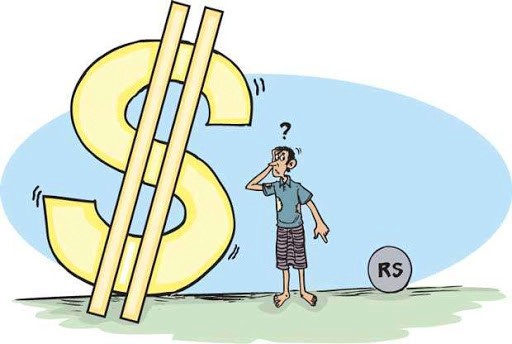
The Sri Lankan rupee has depreciated by an unprecedented 44.3 percent against the US dollar as of yesterday, following the sudden decision taken by the previous Central Bank administration to float the currency on March 7.
The Central Bank noted that rupee which was kept fixed around Rs.202-203 per US dollar till early March had recorded a substantial decline following the decision to let it go by former Central Bank Governor Ajith Nivard Cabraal.

“The subsequent market adjustment due to heightened pressure in the domestic foreign exchange market resulted in an overshooting of the exchange rate.
Accordingly,during the year up to 12 May 2022, the rupee recorded a depreciation of 44.3 percent against the US dollar,” the Central Bank said.

Meanwhile, reflecting cross-currency movements, the Sri Lanka rupee also depreciated against the euro, the pound sterling, the Japanese yen, the Australian dollar, and the Indian rupee by 40.1 percent,38.6 percent 37.2 percent, 41.8 percent and 42.1 percent, respectively as at May 12.

Sri Lanka crisis: How war heroes became villains -BBC

Sri Lanka is at a crossroads as an economic crisis upends the lives of its 22 million people. The Rajapaksa brothers, hailed by many as heroes for winning the civil war, are now reviled as leaders. How did this happen and what comes next?

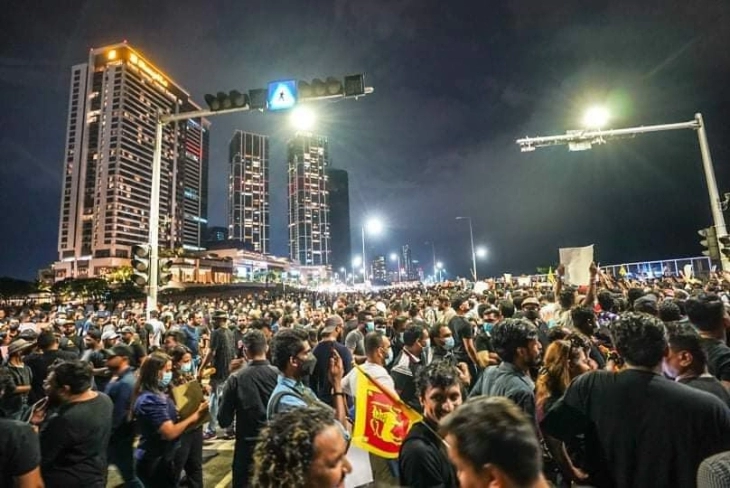
Since early April protesters had been demanding that President Gotabaya Rajapaksa and Mahinda, his prime minister, quit for leading the country to economic ruin – but this week saw a decisive turning point.

First, Mahinda Rajapaksa resigned after his supporters attacked anti-government protesters, triggering deadly clashes across the country. Dozens of houses of politicians were torched, including some owned by the Rajapaksas.

Mr Rajapaksa, 76, had to be evacuated from his official residence after it was besieged by angry crowds.

He’s holed up in a naval base in the north-east for his safety. A court has banned him from leaving the country – utter humiliation for a man who was twice president.

His departure has done nothing to ease the growing pressure on his beleaguered younger brother, 72.

So far the president has ignored the calls to quit, although he has now been forced to offer some concessions. He agreed to transfer some his executive powers to parliament, and has appointed political veteran Ranil Wickremesinghe as the new prime minister heading a proposed cross-party government.

But his political future is very much still on the line, and some believe it’s only a matter of time before he’s forced to go.

Sri Lanka can scarcely afford further political instability as it stares at its worst economic crisis since independence from Britain. People are seething with anger over soaring prices and shortages of food and fuel.

It’s a dramatic fall from grace for a family that has dominated Sri Lankan politics for more than a decade.

Mahinda Rajapaksa was once celebrated by the majority Sinhalese as a hero for bringing an end to nearly three decades of civil war when the Tamil Tiger rebels were crushed in 2009 during his first term as president.

At victory parades and mass public events soon after the war he was compared to Sinhala Buddhist kings.

“He was the most popular Sinhala Buddhist leader in post-independence Sri Lanka. Some even hailed him as Emperor Mahinda,” says veteran political analyst Kusal Perera.

In his 2017 book Rajapaksa: The Sinhala Selfie, Mr Perera highlights the Rajapaksa family’s role in the island’s politics and how Mahinda groomed himself for power.

His father was a parliamentarian and Mahinda gradually rose from opposition leader in parliament to prime minister in 2004.

When he became president a year later, he made Gotabaya defence secretary. It was a big career jump for the younger brother who was living a quiet life in the US after retiring from the Sri Lankan military.

Gotabaya came back for his brother’s campaign and rose to prominence, earning a reputation for ruthlessness.

Soon, other brothers and relatives joined the government. It was Mahinda, the family patriarch, who was instrumental in establishing the Rajapaksa empire.

Up to now the brothers have always stood together. But cracks started appearing recently, especially after Gotabaya asked Mahinda to “take one for the team” and heed protesters’ calls to resign.

The demand was a huge snub for a man who brought his younger brother into government – and certainly not the way he wanted to end his political career.

“He was basically pushed to the wall and forced to leave in a huge youth protest that he fumbled in handling. His age will hold against his return,” Mr Perera says.

Mahinda’s eldest son, Namal, denies the brothers have a problem.

“But definitely there is a policy difference between the president and the [former] prime minister,” he told the BBC before this week’s resignation.

He said his father had been always with the farmers and the masses, whereas Gotabaya Rajapaksa had a different approach “looking more into the floating vote rather than the masses or hardcore SLPP [governing party] vote”.

Protesters may be glad Mahinda Rajapaksa has resigned, but they remain determined Gotabaya must do so too, something his supporters rule out.

“Just because there’s chaos outside – for which there are very valid reasons, we all agree – that does not necessarily mean that he should resign,” former media minister Nalaka Godahewa told the BBC.

It’s not clear what the president will do now he has lost the support of the voters that swept him to power in 2019.

Mr Rajapaksa has reportedly told people close to him that he’s not interested in a second term but wants to lead the country out of the economic crisis.

With anti-Rajapaksa sentiment widespread in the country, his options to do that seem limited. Backed into a corner, there are concerns the president, known for his tough approach, could try to use the military to stay in power.

The Rajapaksas were hugely popular among the Sinhala masses for years, despite allegations of serious human rights abuses, ill-treatment of minorities and murderous attacks on the media, for which they were blamed. Most among the Sinhala majority did not speak out then.

But now the whole country is suffering, the cost-of-living protest has united ethnic communities and Sinhalese protesters are even voicing support for minority rights.

“The economic hardship really hit the majority community and suddenly they turned. I think the Rajapaksas who were able to get away with so much for decades were surprised to see this level of anger,” says Bhavani Fonseka, a human rights lawyer.

But the Rajapaksas will not be willing to give up control that easily. They are concerned not only about their political future, but also about their security when a new government takes over.

This might explain the appointment of veteran opposition figure Ranil Wickremesinghe as the next prime minister. He is regarded as having good relations with the Rajapaksas.

Many Sri Lankans, however, are frustrated by the president’s manoeuvring, and are losing patience.

Without stable government it will be difficult to negotiate a loan with the International Monetary Fund or restructure debt. But if the next government doesn’t do that soon, there will be more power cuts and fuel shortages.

“Regardless of who runs this country, we just need our basic needs to be met,” says Chandani Manel, who lives in Colombo.

“I have two children to feed and a family to look after. Politicians can survive with their wealth but not us,” she says.

Posted in Uncategorized

Sri Lanka will have to print money unless taxes are raised: CB Governor

Sri Lanka will have to print money to pay state worker salaries unless taxes were raised, Central Bank Governor Nandalal Weerasinghe said as the country struggles with low revenues after taxes were cut for output gap targeting.

“State workers salaries are paid by money in the Treasury,” Governor Weerasinghe said. “The reason money was printed all this time is because there aren’t enough revenues.

“So revenues have to be increased.

“If there is not enough money the central bank has to monetize it. There is no bar to that. Under the Monetary Law Act we can do it. It is something that should be done.

“If money printing is stopped and salaries are not paid there will be a bigger crisis.

Weerasinghe said interest rates have been raised and 100 percent of the money has been raised from the market in recent weeks. Essential spending included salaries, pensions and domestic debt repayment.

“In addition, if there is an urgent need, we have told the Treasury it will be monetized only if it is essential, if not to delay it,” he said. “That is why the Treasury Secretary issued a circular asking non-priority spending to be stopped.”

“I can clearly say there is no worry of paying state workers salary and pension. Because we can give money which are paid in rupees. But we should do it with some responsibility and we should not do it like it was done previously and increase the inflation to around 40 percent.”

When money is printed under a pegged exchange rate (flexible exchange rate), dollar shortages emerge in a matter of weeks as the new money moves through the credit system and ends up in the forex market as imports or other outflows.

When money is printed over a longer period, boosting domestic credit and broader money supply, domestic inflation goes up, with asset prices (stock and property) also inflating as mal-investment takes place.

In Sri Lanka large volumes of money have been printed to trigger currency crises in the past including when tax revenues were expanding, with the economy also growing, to target gilt yields through a bond auction committee.

Market bids are rejected and money is printed to repay maturing bonds issued to finance deficits of past years. In 2020 and 2021, price controls were placed on bond and bill auctions to keep Treasury bill yields around 5.2 percent.

Disbanding the bond auction committee will take away the ability of the state to to pro-cyclically inject liquidity and fire currency crises by engaging in output gap targeting (Keynesian stimulus), analysts say.
Sri Lanka’s Treasury bill yields are now around 24 percent and large volumes of money is flowing into the market.

The first beneficiaries of printed money are those who receive the money first like state workers or borrowers of commercial banks who get newly printed money from rejected Treasury bill and bond auctions.

Later recipients of the money see higher prices as the currency falls and inflation goes up.

Sri Lanka printed large over two trillions of rupees over two years, while operating an intermediate regime (soft-peg) and ran out of reserves, losing the ability to maintain the peg at that interest rate.

An attempt to shift the broken soft-peg to a clean float has so far not fully succeeded and the rupee had fallen with forex shortages persisting.

A floating exchange rate, as found in advanced nations operate without any foreign reserves, with foreign exchange inflows and outflows matching each other outside the reserve money which remains stable and unaffected from changes made through central bank purchases and sales of dollars.

Posted in Uncategorized

US, India look forward to work with new Sri Lanka PM

The envoys of the United States and India have expressed their willingness to work with Sri Lanka’s new Prime Minister Ranil Wickremesinghe and a new government.

The U.S. Ambassador to Colombo Julie Chung said the appointment of Ranil Wickremesinghe as the new PM and the quick formation of an inclusive government are the first steps to resolve the crises and she looks forward to work with the new Premier.

“Look forward to working with Ranil Wickremesinghe. His appointment as PM, and the quick formation of an inclusive government, are first steps to addressing the crisis & promoting stability. We encourage meaningful progress at the IMF & long-term solutions that meet the needs of all Sri Lankans,” Chung tweeted.

Posted in Uncategorized

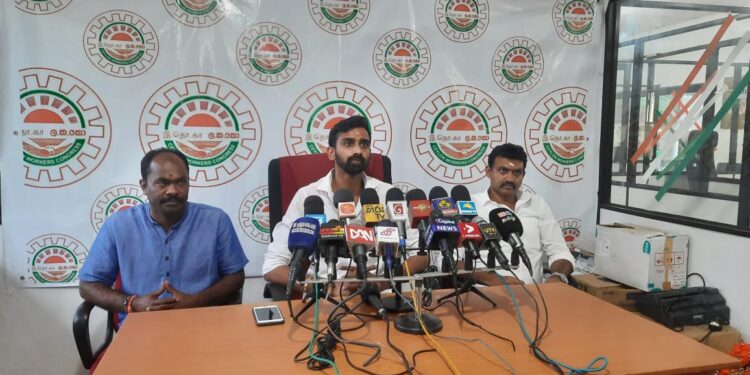
CWC offers fullest cooperation to RW to address issues

The Ceylon Workers’ Congress (CWC) has offered its fullest cooperation to Prime Minister Ranil Wickremesinghe to address critical issues in the country.

CWC General Secretary Jeevan Thondaman extended his wishes to Ranil Wickremesinghe on being appointed as the new Prime Minister.

“However, there are many issues that need to be addressed without delay and I assure the fullest cooperation of the Ceylon Workers’ Congress in your effort to overcome those issues and stabilise our nation,” he tweeted.

Wickremesinghe is the sole UNP member in Parliament.

Ranil Wickremesinghe had been sworn in as the Prime Minister of Sri Lanka on five previous occasions.

He was first appointed as PM from 1993 – 1994 after the assassination of President Ranasinghe Premadasa.

From 2001 to 2004 he was elected as the Prime Minister to lead the United National Front Government during the presidency of President Chandrika Bandaranayake.

In January 2015, he was appointed as the Prime Minister under President Maithripala Sirisena.

He was elected as Prime Minister at the Parliament election in August 2015.

In December 2018, then President Sirisena was compelled to appoint him as PM after having dismissed him in October 2018.

Posted in Uncategorized

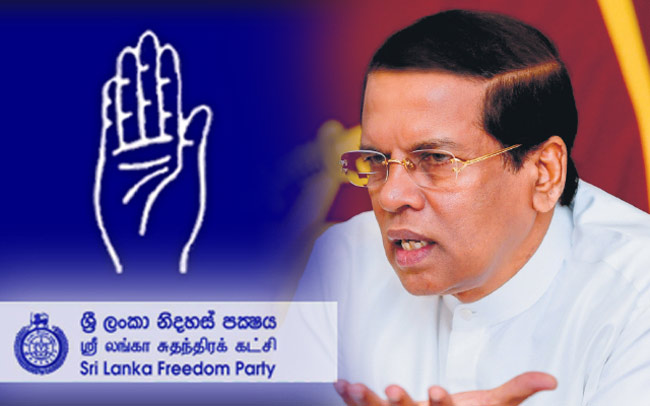
SLFP undecided on supporting PM Ranil

The Sri Lanka Freedom Party (SLFP) is yet to decide on whether or not to extend its support to newly appointed Prime Minister and United National Party Leader MP Ranil Wickremesinghe so that he could command a majority in Parliament.

Speaking to The Morning, SLFP General Secretary MP Dayasiri Jayasekara said that the final decision on the matter is yet to be taken.

According to sources, the SLFP and the group of “independent” government Party (Sri Lanka Podujana Peramuna [SLPP]) MPs in Parliament had proposed the names of MPs Nimal Siripala de Silva, President’s Counsel Dr. Wijeyadasa Rajapakshe, and Dullas Alahapperuma for the post of the Prime Minister.

Meanwhile, the SLPP and former Prime Minister and incumbent MP Mahinda Rajapaksa has reportedly extended his support to Wickremesinghe.

Yesterday (12) evening, Wickremesinghe replaced Rajapaksa who resigned from the post on Monday (9) as unrest broke out in Sri Lanka.

Posted in Uncategorized

Cardinal, Omalpe Sobitha Thera against Ranil as PM

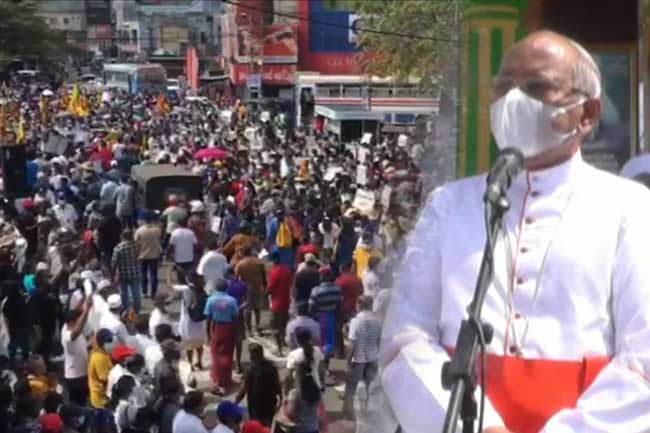
Religious leaders today opposed the decision made by President Gotabaya Rajapaksa to appoint UNP Leader Ranil Wickremesinghe as the new Prime Minister.

Archbishop of Colombo Cardinal Malcolm Ranjith said Mr. Wickremesinghe does not command a majority in Parliament. “ Mr. Wickremesinghe is the only MP who represents his party. Therefore the appointment is not legal,” he said.

“President should listen to the request made by the Mahanayaka Theras who wanted a nonpartisan person to be appointed as the Premier,” he added.

Venerable Omalpe Sobitha Thera said the President has no right to go against the will of the people. “ People never expected this kind of Prime Minister. The Former Prime Minister also deceived the people and left creating a mess. President also seems to be following the same path,” he said.

Venerable Thera said the request that has been made by Leader of Opposition Sajith Premadasa to be appointed as the Premier should be heeded by the President. A non partisan person should come forward through the leader of the opposition. The President should have a dialogue with everyone concerned,” he added.

Posted in Uncategorized

From rejected MP to chosen PM

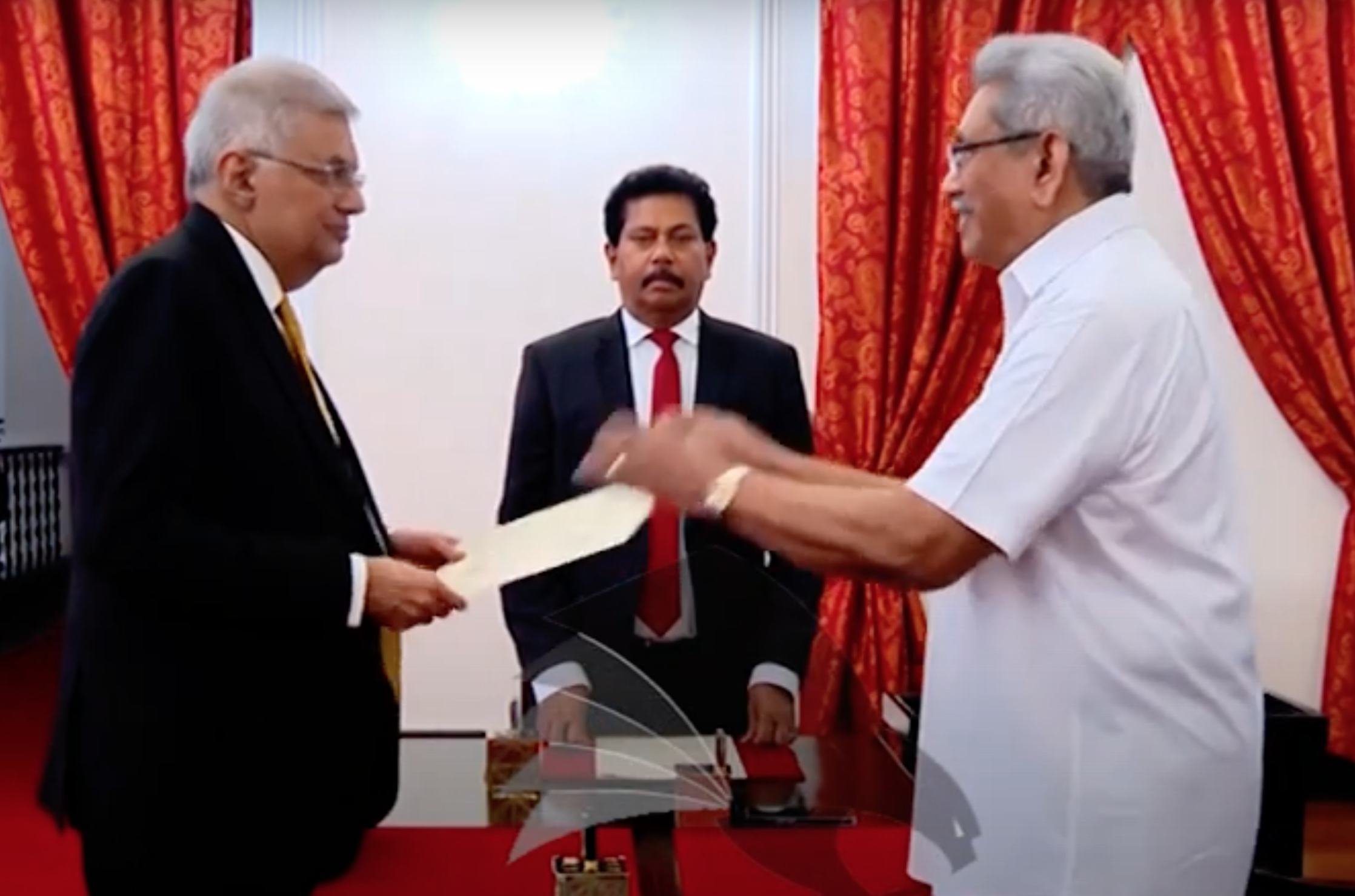
Completing a stunning comeback, United National Party (UNP) Leader and National List MP Ranil Wickremesinghe, who failed to secure his seat in Parliament in the August 2020 General Election, was sworn in as the new Prime Minister last evening (12).

Wickremesinghe took oaths before President Gotabaya Rajapaksa at the President’s House, with Secretary to the President Gamini Senarath and Prof. Maithree Wickremesinghe also present on the occasion.

Wickremesinghe has served as Prime Minister of Sri Lanka on five previous occasions. Following a humiliating defeat for himself and the UNP at the General Election in August 2020, he entered Parliament last year through the sole National List seat won by the party.

When inquired by a foreign journalist whether he has the moral mandate to become the PM, being the sole MP from his party, Wickremesinghe made reference to former British Prime Minister Sir Winston Churchill, who served as Prime Minister of the UK from 1940 to 1945, during the Second World War, and again from 1951 to 1955.

“Churchill had only four Members of Parliament backing him in 1939. How did he become Prime Minister? Because of the crisis (a reference to the Second World War). I have done the same,” he said.

President Rajapaksa and Wickremesinghe held a round of discussion on Wednesday evening (11), during which the new appointment for the vacated premiership and the present crisis situation in the country was discussed at length.

Wickremesinghe’s appointment comes after Mahinda Rajapaksa resigned as Prime Minister following an attack on peaceful protestors camped outside the Temple Trees and the “GotaGoGama” protest site at Galle Face Green by a mob of ruling party supporters on Monday (9), which led to retaliatory attacks around the country and public furore.

The resignation of Mahinda Rajapaksa was later notified in a Gazette Extraordinary published on Monday, under the directives of the President.

Soon after the swearing-in of Wickremesinghe, former Prime Minister Mahinda Rajapaksa, who was reportedly relocated to the Sri Lanka Navy Dockyard in Trincomalee due to security reasons, congratulated his successor.

“Congratulations to the newly appointed Prime Minister of #lka, @RW_UNP. I wish you all the best as you navigate these troubled times,” Rajapaksa Tweeted.

The citizens of the island nation have been showing their discontentment with the incumbent Government as they continue to stand in long queues to meet their basic necessities, including food and medicines.

It was reported last week that the President had requested Mahinda Rajapaksa to vacate the premiership, in order to allow the formation of a government of national unity, an interim arrangement until the present economic crisis could be dealt with.

Rajapaksa’s resignation as the Prime Minister came after several rounds of discussions among the ruling Sri Lanka Podujana Peramuna Party (SLPP) and its constituent parties. The PM’s departure also resulted in the dissolution of the Cabinet.

Sri Lanka: debt crisis, neocolonialism and geopolitical rivalry

By ASOKA BANDARAGE – AsiaTimes

Sri Lanka is in the throes of an unprecedented economic crisis. Faced with a shortage of foreign exchange and defaulting on its repayments of foreign debt, the country is unable to pay for its food, fuel, medicine, and other basic necessities. Notwithstanding the austerities that would be entailed, a bailout by the International Monetary Fund (IMF) has been accepted as the only way out of the dire economic situation.

Opposition political parties and citizens across the country blame the Rajapaksa government’s widespread corruption and mismanagement for the crisis, and demand that the president and the Parliament resign.

Prime minister Mahinda Rajapaksa did so on May 9. However, the protesters at Galle Face Green, an urban park in central Colombo, and elsewhere have not been able to put forward an alternative leadership or a viable roadmap for the future. The country remains mired in confusion, chaos and a highly volatile political impasse.

To understand the complexity of the current crisis, and to prevent us falling back into the same paralyzing debt cycle, it is necessary to move beyond domestic politics and the relentless news cycles of corporate media and explore some of the commonly overlooked yet basic global economic and geopolitical dimensions.

Debt crises and global inequality
The transfer of financial and resource wealth from poor countries in the Global South to the rich countries in the North is not a new phenomenon. It has been an enduring feature throughout centuries of both classical and neo-colonialism. At the start of 1989, developing nations owed foreign creditors US$1.3 trillion, that is, “just over half their combined gross national products and two-thirds more than their export earnings.”

Recently, the effects of the war in Ukraine and the Covid-19 crisis have worsened the high debt burdens of developing countries. These countries were already struggling to pay accumulated debts stemming from the expansion of capital flows from the high-income countries to lower-income countries after the 2008 global financial crisis.

Financial liberalization was fostered by powerful global interests, including the IMF, when interest rates dropped in the richer countries. This facilitated borrowing by developing countries from private international capital markets through international sovereign bonds (ISBs), which come with high interest rates and short maturation periods.

Financial liberalization facilitated by the IMF and the developed countries working with the domestic elites of poor countries has created a hierarchical and asymmetrical international financial architecture.

As a December 2021 report published by the Bretton Woods Project points out, this unequal framework creates “macroeconomic imbalances, financial fragilities, and exchange-rate instability that can trigger debt and/or currency crises and curb the economic policy autonomy of affected countries to pursue domestic goals.”

The international non-governmental organization Debt Jubilee Campaign (soon to be called Debt Justice) has pointed out that 54 countries are now experiencing a debt crisis.

According to the World Bank, Sri Lanka owes $15 billion in bonds, mostly dollar-denominated, out of a total of $45 billion to $50 billion in long-term debt. The country needs $7 billion to $8.6 billion to service its debt load in 2022, whereas it had just $1.6 billion in reserves at the end of March 2022.

The downgrading of Sri Lanka by rating agencies such as Moody’s added to the difficulty of further borrowing to pay off the debt. The devaluation of the Sri Lankan rupee by 32% since the beginning of the year has made it the world’s worst performing currency, according to economists, exacerbating the plight of the Sri Lankan people.

The multilateral Asian Development Bank and the World Bank own 13% and 9% of Sri Lanka’s foreign debt respectively. Currently, China is Sri Lanka’s largest bilateral lender, owning about 10% of its total foreign debt, followed by Japan, which also owns 10%.

About half of Sri Lanka’s total foreign debt (55% according to some estimates) is market borrowings through US- and EU-based ISBs. Asset managers BlackRock and Ashmore Group along with Fidelity, T Rowe Price and TIAA, are among Sri Lanka’s main ISB creditors. However, the information on the ownership of ISBs – including one worth $1 billion that will mature on July 25 – is not publicly revealed.

Sri Lanka is in negotiations with the IMF on restructuring and repaying its massive debt. IMF structural adjustment will include the familiar privatization, cutbacks of social safety nets and alignment of local economic policy with US and other Western interests, to the further detriment of local working people’s standard of living and inevitably leading to more wealth disparity and repeat debt crises.

Debt crisis and geopolitical rivalry
Economic crises create opportunities for external powers to expand economic exploitation and geopolitical control. In Sri Lanka’s context, this means India, the US and China.

Sri Lanka’s big neighbor India has extended a $1 billion credit line to provide essential food and medicine. The Sri Lankan government has stated that there are no conditions attached to the Indian loans. However, Sri Lankan analysts believe that agreements have been made giving Indian companies exclusive access to investments on the island.

Sri Lanka is strategically located in the sea lanes of the Indian Ocean. More than 80% of the global seaborne oil trade is estimated to pass through the chokepoints of the Indian Ocean. Although bizarrely overlooked by the global media, a cold war is already in place between China and the Quadrilateral Alliance (United States, Japan, Australia and India) over the control of Sri Lanka and the Indian Ocean.

Sri Lanka is part of China’s $1 trillion Belt and Road Initiative, which includes the island’s Hambantota Port and Port City. The United States, on the other hand, signed an open-ended Acquisition and Cross Services Agreement (ACSA) with Sri Lanka on August 4, 2017, facilitating military logistic support.

The US is also seeking to sign a Status of Forces Agreement (SOFA), which would in effect turn Sri Lanka into a US military base. While the proposed US Millennium Challenge Corporation Compact has not been signed because of local protests, the pact’s objective – US control over the land, transportation and communication infrastructure in Sri Lanka – continues unabated.

In this context of Sri Lanka as a tense theater of geopolitical rivalry, the debt crisis cannot be understood simply as an economic crisis. Could it, in fact, be a “staged default” designed to push Sri Lanka into an IMF bailout that would complete the island’s subservience to the US-dominated economic and political agenda?

Alternative sustainable approaches
The young “Gotta Go Home!” protesters who demand President Gotabaya Rajapaksa’s resignation seem to be unaware of the global dynamics of the Sri Lankan crisis. Perhaps local and foreign interests guiding the protests may want to keep it that way.

They are certainly not encouraging the protesters to join global calls for much-needed debt cancellation, debt swaps and regulation of capital market borrowing to prevent debt crises occurring in the first place.

However, at least a few Sri Lankan professionals concerned about the implications of an IMF bailout have put forward alternative short and long-term solutions. They recognize that while exploitative colonial and neocolonial policies have turned Sri Lanka into a poor and desperate country, the island is rich with abundant natural resources and human capital.

If the land and ocean and the graphite, ilmenite and other mineral resources are sustainably utilized, Sri Lanka can be economically self-sufficient and prosperous. There is also much to be learned from Sri Lanka’s pre-colonial history in this regard, not least its hydraulic civilization.

The Committee on Public Accounts has revealed that there are enough oil and natural-gas deposits in the Mannar Basin to meet the entire country’s needs for 60 years. If the abundant sustainable solar and wind power are also utilized, Sri Lanka can become not only energy self-sufficient, but an exporter of energy as well.

Bioregionalism, economic democracy, and food and energy sovereignty are the only route to a sustainable future for Sri Lanka and other debt-trapped countries, and indeed the world at large.

To overcome the dominant forces seeking to monopolize control over the natural environment and humanity, people – especially the young – need to awaken and work in partnership with one another to fight the destructive greed that ensnares and threatens to destroy us.


Debt restructuring talks unaffected by unrest, assure IMF and CBSL

Both the International Monetary Fund (IMF) and the Central Bank of Sri Lanka (CBSL) yesterday (11) assured that despite the recent unrest, political instability, and resultant islandwide curfew, technical-level discussions on Sri Lanka’s debt restructuring would be carried out as usual.

Issuing a statement in response to media queries, the IMF yesterday (11) stated that despite the unrest that has been created in the country with the resignation of Prime Minister Mahinda Rajapaksa, the virtual mission which was to commence from 9 May until 23 May is to continue, so as to prepare for policy discussions that will take place under a new government.

“On our virtual mission during 9-23 May, discussions at the technical level have just started and will continue as planned, so as to be fully prepared for policy discussions once a new government has been formed.”

Meanwhile, CBSL Governor Dr. Nandalal Weerasinghe stated that since technical discussions are a standard process, they will be carried out as usual; however, policy implementations will require decisions to be made by state authorities.

“Active state institutions should be there to approve and implement fiscal policy decisions,” Weerasinghe said.

This statement was issued following local economists as well as Citigroup Global Markets expressing their concern over the repercussions that the country may face due to the declared state of emergency as a result of the political instability in the island.

The economists assumed that the negotiations with the IMF might be delayed, and thus entering into the IMF programme would take over six months. At the same time, on Tuesday (10), Bloomberg cited Citigroup as saying that the investment banking company foresees a possibility of delays in bailout talks.

The IMF statement further read that they are following the developments in Sri Lanka and “are concerned about rising social tensions and violence”.

However, the IMF said that they are to remain committed to assist the country in line with the IMF’s policies.

On Tuesday (10), speaking to The Morning Business, former Ceylon Chamber of Commerce Chairman Chandra Jayaratne expressed that the discussions with the IMF relating to debt sustainability could be carried out by relevant officials such as CBSL Governor Dr. Weerasinghe and Treasury Secretary Mahinda Siriwardena, without endorsement from Sri Lanka, as there is no official government in place after the resignation of the Prime Minister.

However, Jayaratne added that when it comes to presenting the plans for debt repayment in the future based on forecasts, the endorsement of the Government is required in implementing certain policies, such as reduction of expenditure, increase of government revenue, transfers for the poor to ease their suffering and other reforms.

Posted in Uncategorized