JVP Sees Local Polls As National Referendum

The ability to change leaders is a fundamental right and if the government delays Sri Lanka’s upcoming local government polls, the people must take to the streets, surround the president’s house and parliament if needed, and demand that the election be held, opposition Janatha Vimukthi Peramuna (JVP) former legislator K. D. Lal Kantha said.

He said the local government election, scheduled to be held in March, has assumed the importance of a national referendum and must be treated as one.

Addressing a group of indigenous medical practitioners at an event, Lal Kantha said that if the people cannot change their leaders through an election, those leaders must be “beaten and kicked out.” (gahala pannanna oney).

“The people of Sri Lanka have changed and as a result the leaders are also compelled to change,” he said.

By delaying elections, he said, the leaders are giving the people a different message: “Kick us out.”

The former MP said the message would be that Sri Lankans must kick them out the way they did former President Gotabaya Rajapaksa, who was forced to resign after a wave of popular protests.

Posted in Uncategorized

Marine Exercise of CARAT-2023 commences in Mullikulam

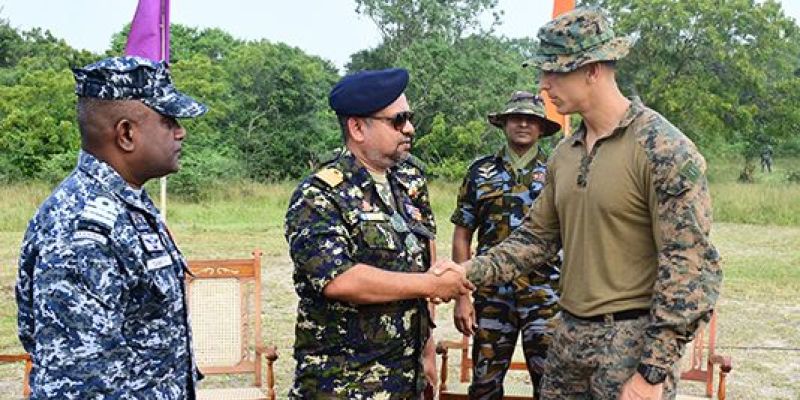
The Marine Exercise of Cooperation Afloat Readiness and Training (CARAT) 2023 commenced in Mullikulam yesterday (21).

The opening ceremony was held under the patronage of Commanding Officer SLNS Barana, Captain Sanjeewa Kodikara and Company Commander, 2nd Battalion, 4th Marines of US Marine Corps, Captain Shan Mandrayar.

The Sri Lanka Navy said this also marked the commencement of shore phase training of CARAT -2023, where Tactical Combat Casualty care (TCCC), Combat Life Saving CLS), Jungle Warfare, Military Operation in Urban Terrain (MOUT) and Rescue Operation training exercises were performed.

The exercises were carried out by personnel of Sri Lanka Navy Marines, Special Boat Squadron, Rapid Action Boat Squadron, Naval Infantrymen, and U.S. Marine Corps.

Sri Lankan Tamils seek India’s support in addressing socio-economic problems

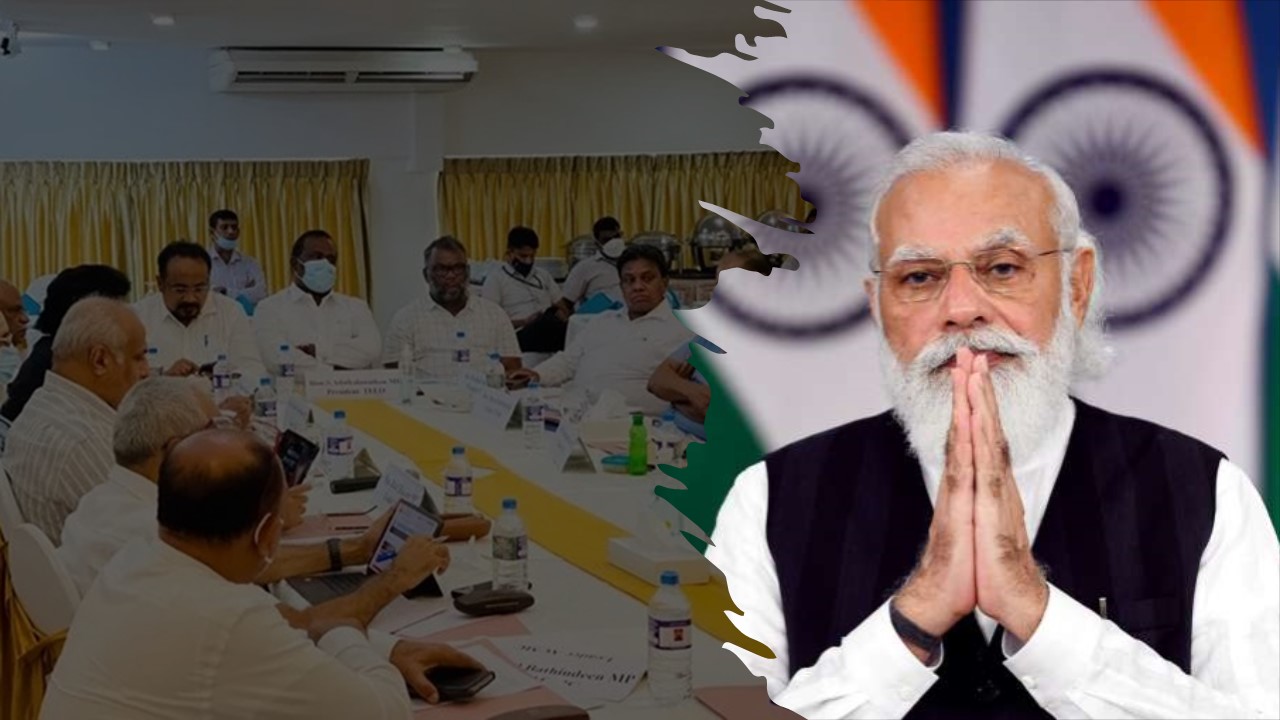
Members of the Tamil community in Sri Lanka has sought help from India in addressing their socio-economic problems, during External Affairs Minister Dr. S. Jaishankar’s two-day visit to the island nation.

“Jeevan Thondaman, Minister of Water Supply and Estate Infrastructure Development-led Ceylon Workers’ Congress leaders and leaders of Tamil Progressive Alliance highlighted the socio-economic difficulties faced by people of plantation areas and sought India’s support in addressing their problems,’’ the Indian High Commission in Sri Lanka said in a statement.

The interaction of minister Jaishankar with the leadership of the government of Sri Lanka provided an opportunity to review the whole gamut of bilateral relations between the two countries, the MEA said.

He stressed his presence in Sri Lanka at a time when the country was going through multiple challenges sent a clear and strong message of continued support from the Government and the people of India to the people of the island-nation.

On Friday (20 Jan.), Jaishankar said full implementation of the 13th amendment in the island country is critical for achieving reconciliation with the minority Tamil community.

‘‘India has always supported both the political and economic stability of Sri Lanka. The President briefed me on the question of political devolution and his thinking. I shared with him our considered view that the full implementation of the 13th amendment and early conduct of provincial elections are critical in this regard,” Jaishankar was quoted as saying in a press statement in Sri Lanka.

The 13th Amendment provides for the devolution of power to the minority Tamil community which India has been pressing Sri Lanka to implement.

This amendment was brought in after the Indo-Sri Lankan agreement of 1987.

Jaishankar paid an official visit to Sri Lanka from 19 – 20 January, making this his fourth bilateral visit to the island nation during his tenure as India’s External Affairs Minister.

Jaishankar was accompanied by a four-member official delegation from the Ministry in his latest visit to Sri Lanka, following earlier visits to the island nation in January 2021 and March 2022.

Before Jaishankar’s visit, Sri Lankan President Ranil Wickremesinghe on Sunday said his government is discussing problems of the North and the Tamil people, in a step towards reconciling the island nation that has suffered three decades of war and insurgency.

‘‘We are discussing the problems of the North and the Tamil people. I called all the party leaders to the Parliament and said let us work to unite this country and restore harmony,’’ Wickremesinghe was quoted as saying by the Sri Lankan President’s media division in an address at the National Thai Pongal Festival on Sunday afternoon.

In his address, Wickremesinghe said his government is hoping to fully implement the 13th Amendment to its Constitution not only in the northern part of the country but also in the South.

Source – ANI News

Over 100 nominations for LG election rejected

Several nomination papers submitted by major political parties for the upcoming election have been rejected by the respective district secretariats.

Accordingly, over 100 nominations have been rejected across nearly 15 districts.

Nominations submitted by the United National Party (UNP) to the Haldummulla and Mahiyangana Pradheshiya Sabhas in Badulla have been rejected, while those submitted by the Ceylon Workers’ Congress (CWC) to the Hali-Ela Pradheshiya Sabha were also rejected.

Nomination papers submitted by the newly-formed Freedom People’s Alliance under the helicopter logo were also rejected in Galnawa, Anuradhapura, and in Kantalei, Trincomalee.

Submissions made by the Tamil National Alliance have also been rejected by the Seruwila Pradheshiya Sabha in Trincomalee.

Nomination papers submitted by the All Ceylon Makkal Congress (ACMC), led by MP Rishad Bathiudeen, were also rejected by the Kantalei Pradheshiya Sabha, while those submitted by the Frontline Socialist Party were rejected by the Kuruwita and Kalwana Pradheshiya Sabhas in the Ratnapura district.

Nominations submitted by a total of 10 political parties and three independent groups were rejected by local government institutions within the Kalutara district, whiles ix nomination papers were rejected in Galle.

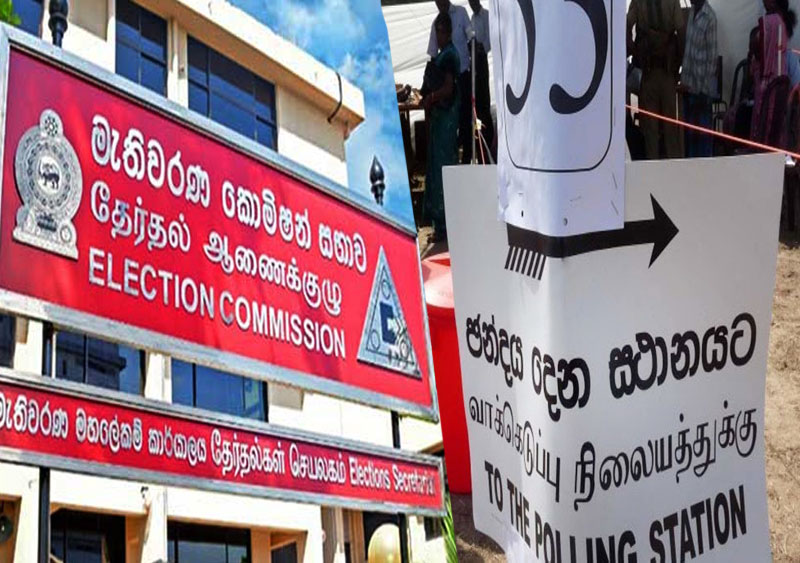
Meanwhile, the Election Commission of Sri Lanka has convened all political parties and independent groups for a meeting pertaining to the upcoming Local Government (LG) election.

Accordingly, the meeting is expected to take place next Tuesday, the Commission noted, making this the first such meeting since the announcing of the 2023 LG election.

Posted in Uncategorized

China offers Sri Lanka support with two-year moratorium on debts

President gets Exim Bank’s letter supporting IMF’s loan programme

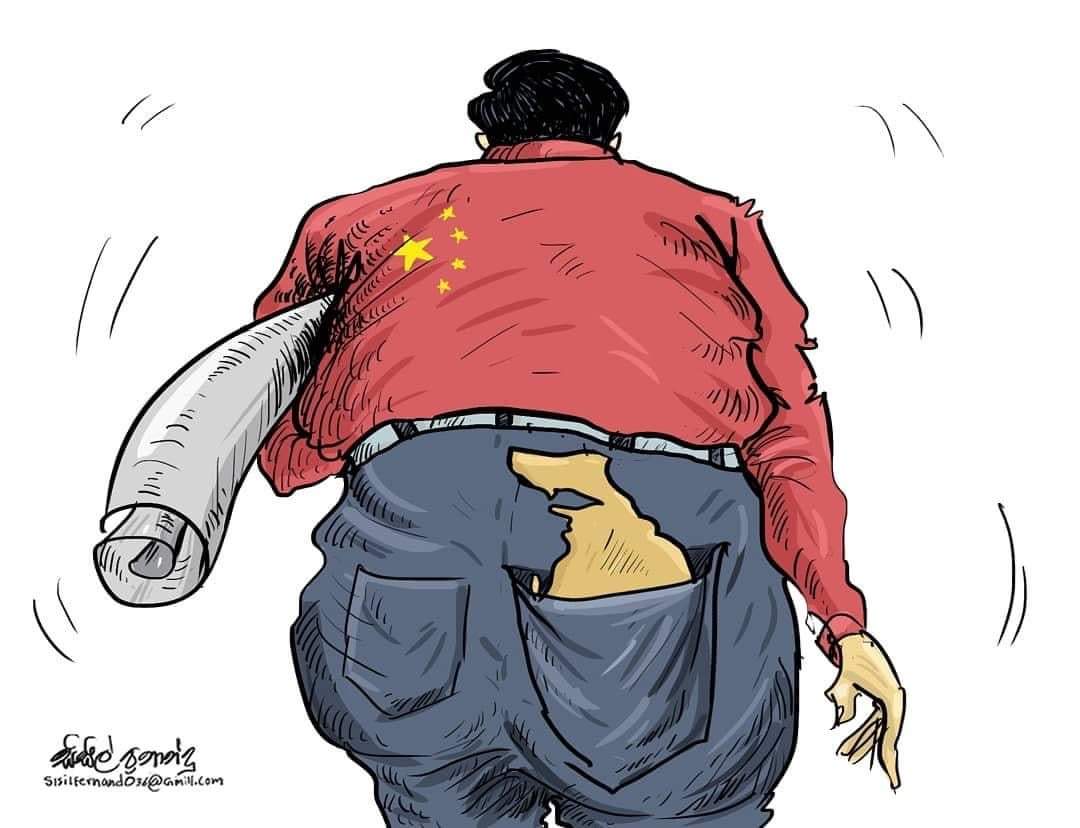
China yesterday responded to Sri Lanka’s long-standing request for a commitment on rescheduling its debts as a prelude to a bailout by the International Monetary Fund (IMF) with an offer for a two-year moratorium, the Sunday Times learns.
In a letter to President Ranil Wickremesinghe in his capacity as Finance Minister, the Exim Bank of China responsible for much of the loans given to Sri Lanka said the two-year moratorium would be a short-term suspension of the debts owed to China while asking all parties, i.e. Sri Lanka’s creditors to get together to work out medium-term and long-term commitments.

It is learnt that the letter also extends China’s support to the IMF’s Extended Fund Facility (EFF) and requests the IMF to go ahead with the discussions on debt restructuring that will lead to an IMF programme.

The letter giving China’s assurances arrived on the eve of a Paris Club meeting of Sri Lanka’s creditors scheduled for next week where Sri Lanka’s debt restructuring measures are to be discussed as a prelude to a US dollars 2.9 million IMF programme to bail out Sri Lanka from its current economic crisis.

Sri Lanka’s efforts to get China’s support along with India’s support for rescheduling its loans were being negotiated for several months.

It comes shortly after India announced that it had written to the IMF extending its assurances in writing that it would support an IMF programme for an Extended Fund Facility for Sri Lanka. China, India and Japan are Sri Lanka’s largest bilateral creditors.

Soon after the Indian assurances were given to the IMF, its External Affairs Minister S. Jaishankar called upon other countries to be “proactive” in supporting Sri Lanka. Dr. Jaishankar who was in Sri Lanka on a 24-hour visit on Thursday and Friday said India was willing to support Sri Lanka “fully” in its efforts to come out of its current financial crisis.

China’s International Department Vice Minister Chen Zhou who was in Sri Lanka earlier in the week, also announced that China was about to announce some “good news” on Sri Lanka’s request to consider rescheduling its debts.

The letter from the Chinese Exim (Export-Import) Bank, the state-run institution responsible for foreign loans, arrived in Colombo on the eve of the Chinese lunar New Year which begins today.

It was not immediately known if the Chinese assurances contained in the letter would meet the requirements of the Paris Club and the IMF.

Participation at the Paris Club by India and China was also not immediately known, but the Sunday Times learns that the Sri Lankan Finance Ministry was confident it was sufficient consent for the IMF to go ahead with discussions on its debt restructuring schedule leading to its bailout programme for Sri Lanka.

Posted in Uncategorized

India considers full implementation of 13A in Sri Lanka ‘critical’: EAM

India considers the full implementation of the 13th Amendment in Sri Lanka “critical” for achieving reconciliation with the minority Tamil community, External Affairs Minister S Jaishankar said on Friday, underlining that New Delhi has always supported both the political and economic stability in the island nation.

India has been pressing Sri Lanka to implement the 13th Amendment which was brought in after the Indo-Sri Lankan agreement of 1987. The 13A provides for the devolution of power to the Tamil community.

Fully implementation of the 13th Amendment to Sri Lanka’s Constitution will facilitate unity among all the communities in the island nation so that they could live as one.

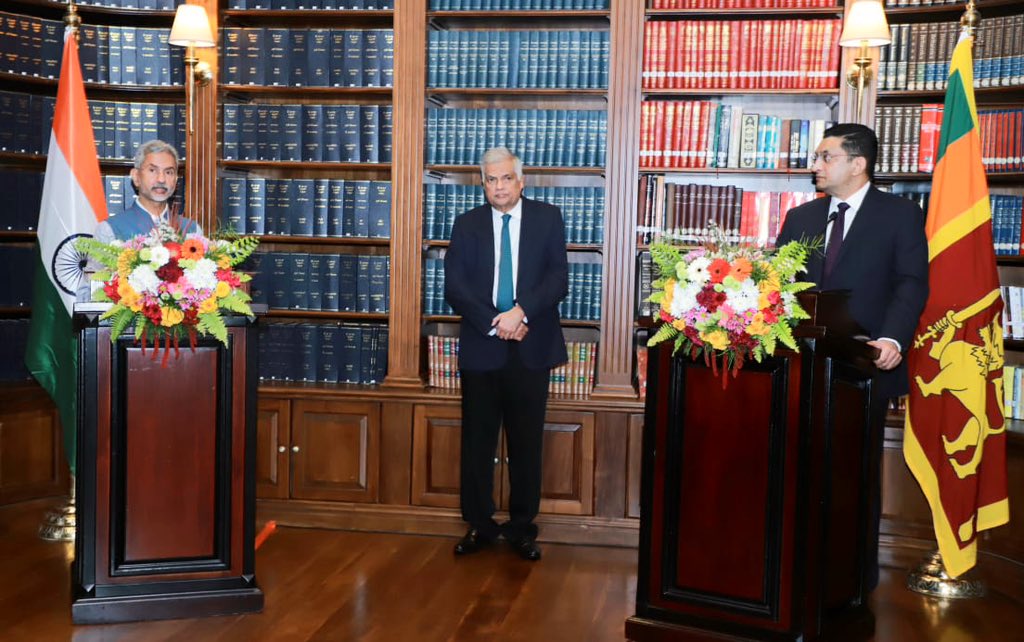
“India has always supported both the political and economic stability of Sri Lanka,” Jaishankar said in a press statement after talks with Lankan President Ranil Wickremesinghe and Foreign Minister Ali Sabry.

He further said that he shared with Lankan President Wickremesinghe, “our considered view that the full implementation of the 13th Amendment and early conduct of provincial elections is critical” for both the political and economic stability of the debt-ridden island nation.

“Durable efforts towards reconciliation are in the interests of all sections in Sri Lanka. I also spoke of the need to pay special attention to the requirements of the Indian-origin Tamil community,” he said.

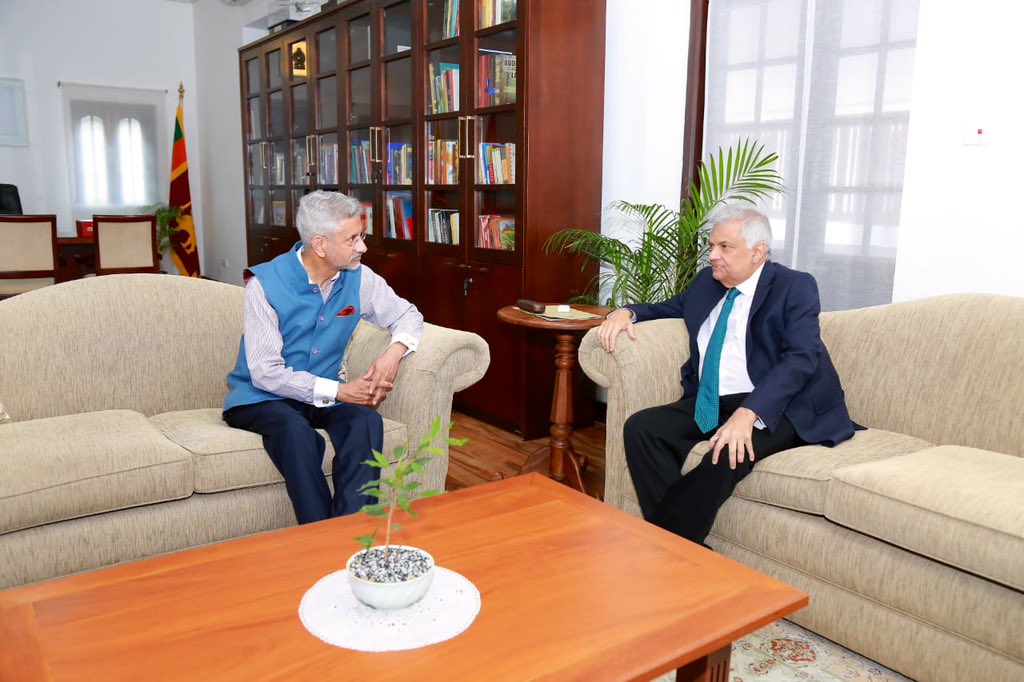
Jaishankar, who is here on a two-day visit, called on President Wickremesinghe on Friday morning.

Sri Lankan President Wickremesinghe on Thursday called for reconciliation and coexistence in the island nation, saying his government has initiated the process by talking to Sri Lankan Tamils and understanding their problems.

He said the government has already started discussions with the Tamil community and will also be talking with the Tamil section in the “Hill Country” to integrate them into the society.

Sri Lanka has had a long history of failed negotiations to end the Tamil claim of discrimination by allowing some form of political autonomy.

An Indian effort in 1987 that created the system of a joint provincial council for the Tamil-dominated north and east faltered as the Tamils claimed it fell short of full autonomy.

Tamils say that not enough power had been devolved to the provincial councils to make them meaningful.

Wickremesinghe himself tried an aborted constitutional effort between 2015-19 which too came to be scuttled by the hardline majority politicians. The Tamils put forward their demand for autonomy since gaining independence from Britain in 1948 which from the mid-70s turned into a bloody armed conflict.

Over the years, the Sri Lankan government has been aggressive against Tamilian groups following its war with the Liberation Tigers of Tamil Eelam (LTTE).

The LTTE ran a military campaign for a separate Tamil homeland in the northern and eastern provinces of the island nation for nearly 30 years before its collapse in 2009 after the Sri Lankan Army killed its supreme leader Velupillai Prabhakaran.

According to Sri Lankan government figures, over 20,000 people are missing due to various conflicts including the three-decade brutal war with Lankan Tamils in the north and east which claimed at least 100,000 lives.

Date for Local Government election announced

The upcoming Local Government (LG) election will be held on 09 March 2023.

This was announced by the Election Commission of Sri Lanka today (21 Jan.).

The accepting of nominations for the upcoming election commenced at 08:30 a.m. on 18 January, and closed at 12 noon today.

The acceptance of cash deposits for the election also closed yesterday (20 Jan.), after it began on 18 Jan.

Meanwhile, the Regulation of Election Expenditure Bill was also passed in Parliament on Thursday (19 Jan.), with a majority of 61 votes.

The Bill was passed in Parliament with 97 votes in favour, while 36 MPs voted against the Bill.

Several political parties in the opposition including the Samagi Jana Balawegaya (SJB), however, expressed their discontent about scheduling the debate for today, citing the government’s attempts to pass the bill hastily in a bid to postpone the local government election, while various election monitoring organisations too, have raised concerns pertaining to the Bill, deeming the law inadequate.

Posted in Uncategorized

Jaishankar’s Colombo visit underscores Delhi’s role as the first responder in crises

Indian External Affairs Minister Dr.S.Jaishankar’s two-day visit to Sri Lanka that concluded on Friday, has underscored and re-affirmed India’s role as the first responder during crisis situations in Sri Lanka.

The visit, which included a meeting with President Ranil Wickremesinghe, raised hopes that India-Sri Lanka cooperation in a variety of economic sectors will increase. Jaishankar has offered further Indian investments and has appealed to the Sri Lankan authorities to create a business-friendly environment that will help attract Indian investments.

Jaishankar told a media briefing that the primary purpose of his visit was to express India’s solidarity with Sri Lanka during these difficult moments when the island nation is facing a deep financial crunch.

“As you all know, last year, India extended about US $ 4 billion in terms of credits and rollovers to help Sri Lanka get through an economic crisis. For us, it was an issue of ‘Neighborhood First’ and not leaving a partner to fend for themselves.”

“This year, in a developing situation that was beginning to cause concern, the same sentiment reasserted itself. We felt strongly that Sri Lanka’s creditors must take proactive steps to facilitate its recovery. India decided not to wait for others but to do what we believe is right. We extended financing assurances to the IMF to clear the way for Sri Lanka to move forward. Our expectation is that this will not only strengthen Sri Lanka’s position but ensure that all bilateral creditors are dealt with equally,” Jaishankar said.

The Indian External Affairs Minisiter stressed the importance of FDIs for the recovery of economies and said: “Sri Lanka’s pathway is one of a strong economic recovery propelled by greater investments. India will encourage greater investments in the Sri Lankan economy, especially in core areas like energy, tourism and infrastructure.”

Jaishankar then stated an important point – a flaw in the attitude of successive Sri Lankan governments’ FDI policies. He said: “We count on the Government of Sri Lanka to provide a more business-friendly environment to create a powerful pull factor. I am confident that the gravity of the situation is realized by policy-makers here.”

The Indian Minister laid out the areas in which Sri Lanka could count on Indian help. He particularly mentioned connectivity, energy and the development of Trincomalee as an energy hub.

“Energy security is today one of Sri Lanka’s most serious challenges. A search for solutions must necessarily encompass the larger region. Only then will Sri Lanka get the full benefit of scale. This country has enormous renewable energy potential that can become a sustainable source of revenue.”

“India is prepared to be a reliable partner on such initiatives. We have today agreed in-principle on a renewable energy framework that would take this cooperation forward,” Jaishankar said.

Recognizing the tourism is the life blood of the Sri Lankan economy, Jaishankar noted that Indian tourists are expressing their “positive sentiments for Sri Lanka in a very practical manner by coming here.” But more will come if connectivity is improved and if Indian tourists are able to make payments in Indian Rupees and the utilization of UPI would be most helpful in this regard, he added.

Indian Rupee payments will also boost Indo-Lankan trade, he said. “In a turbulent world, it is essential that India and Sri Lanka steady their trade. The use of rupee settlement for trade is obviously in our mutual interest,” Jaishankar said.

On political issues in Sri Lanka in which India has been historically interested, Jaishankar said that India has always supported both the political and economic stability of Sri Lanka. He said that he told President Wickremesinghe that the full implementation of the 13th amendment of the Sri Lankan constitution which devolves powers to the provinces will promote reconciliation and national stability. He also stressed the need for the early conduct of provincial elections. Durable efforts towards reconciliation are in the interests of all sections in Sri Lanka, he added.

Referring to the Indian Origin Tamils, he said that he spoke to the President about the need to pay “special attention” to the requirements of this community.

Jaishankar then sad that he had handed over to Wickremesinghe, Indian Prime Minister Narendra Modi’s invitation to visit India “at an early date to discuss how our partnership can facilitate Sri Lanka’s strong recovery.”

In conclusion, Jaishankar underlined that India is a “reliable neighbor, a trustworthy partner, one who is prepared to go the extra mile when Sri Lanka feels the need.”

“My presence here today is a statement about Prime Minister Modi’s commitment to Neighbourhood First. We will stand by Sri Lanka in this hour of need and are confident that Sri Lanka will overcome the challenges that it currently faces,” he said.

Lankan View

In his statement to the media, the Sri Lankan Foreign Minister Ali Sabry expressed “profound gratitude” to the Indian Prime Minister, External Affairs Minister and the Indian people for their “enormous support” when Sri Lanka was facing the most serious economic crisis in its history. He appreciated India’s official offer of financial assurances at a time when Colombo’s talks with the IMF for a relief package were at a crucial stage.

Sabry said that Sri Lanka is watching India’s growth with great interest as in its view, India’s growth is good for the region and Sri Lanka. He congratulated Prime Minister Modi and Jaishankar for giving an “intellectual impetus” to a new foreign policy.

The Lankan Foreign Minister announced Indian aid for “high impact” community development and housing projects in Anuradhapura, Kandy, Nuwara Eliya and Galle districts.

Jaishankar in the Maldives

Earlier, during a visit to the Maldives, Jaishankar signed agreements. MVR 100 million grant will be given for high-impact community development projects, under which a sports complex will be constructed in Gaafu Dhaalu Gadhdhoo. There is an agreement for assistance and cooperation between the Maldives National University and Cochin University in India. India also made a donation of two sea ambulances. He inaugurated the Indian-aided Hanimaadhoo Airport Development Project. The Hanimaadhoo Airport project will connect the world with the northern islands of the Maldives.


Jaishankar meets Mahinda before concluding visit

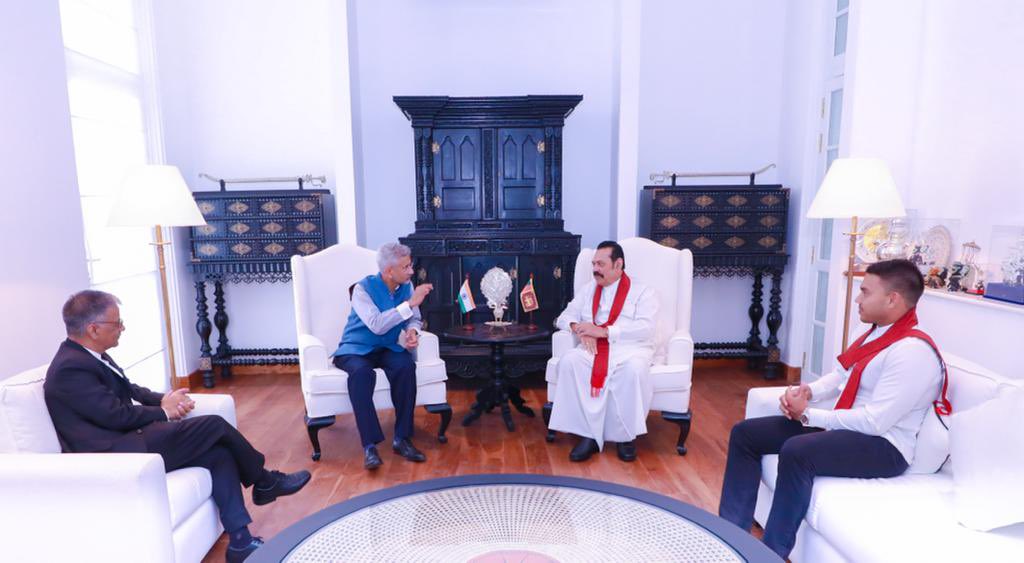
Indian External Affairs Minister Dr. S. Jaishankar had talks with former President Mahinda Rajapaksa before concluding his visit to Sri Lanka.

Rajapaksa tweeted saying he had a successful discussion with Jaishankar and that they discussed a range of issues of mutual interest.

“Also thanked the Indian govt. for it’s steadfast commitment in assisting Sri Lanka during its troubled times & the strong ties shared between Sri Lanka and India,” Rajapaksa tweeted.

During the visit to Sri Lanka, Minister Jaishankar held bilateral discussions with Minister of Foreign Affairs Ali Sabry on 19 January 2023 and was hosted to dinner by the Foreign Minister.

On behalf of President Ranil Wickremesinghe, the Government and the people of Sri Lanka, Minister Sabry conveyed gratitude to his Indian counterpart for the significant assistance extended by India to Sri Lanka in the past year, of USD 4 billion in credit lines as well as other in-kind assistance, when the country was going through its most serious economic crisis.

Minister Sabry also appreciated India’s announcement, as the first country to officially back Sri Lanka’s IMF-led debt restructuring programme by conveying financing assurances to the International Monetary Fund.

The Indian Minister reiterated that the primary purpose of his visit to Colombo was to express India’s solidarity with Sri Lanka in difficult times in line with the ‘Neighbourhood First’ policy of Prime Minister Modi. It was India’s intention to clear the way for Sri Lanka to move towards recovery and growth.

Bilateral discussions between the two Foreign Ministers and the respective delegations included Foreign Secretary Aruni Wijewardane and Indian High Commissioner Gopal Bagley and focused on several areas of possible further collaboration for mutual benefit. It was agreed that greater connectivity including through tourism would encourage enhanced people to people contact and economic activity.

Sustainable energy security was identified by both sides as one of the most urgent upcoming challenges, and agreement was arrived at in principle for the need for a framework for cooperation for renewable energy.

Foreign Minister Sabry noted that India was one of the fastest growing economies in the world. Sri Lanka recognizes that India’s growth would provide opportunities for Sri Lanka as India is Sri Lanka’s largest trade partner, the largest source of inward tourism and one of the largest investors.

On the occasion of the visit, a number of important initiatives were concluded in the presence of President Wickremesinghe at the Presidential Secretariat.

This included the signing of an MOU on Indian Grant Assistance for implementation of High Impact Community Development Projects (HICDP) which focused on socio-economic development, infrastructure in education, health and community development sectors. Minister Jaishankar also participated in three virtual inauguration ceremonies to handover the Kandyan Dancing Academy under the Sri Dalada Maligawa Heritage Project, to handover 24 houses each in Anuradhapura and Badulla Districts under the Model Housing Village Project and to handover 300 houses under Phase-3 of the Indian Housing Project: 100 houses each in Kandy, Nuwara Eliya and Galle Districts.

Minister Jaishankar also handed over Prime Minister Narendra Modi’s invitation to President Ranil Wickremesinghe to visit India at an early date to discuss how India could further facilitate Sri Lanka’s strong recovery.

External Affairs Minister Dr. S. Jaishankar was accompanied by Joint Secretary (IOR) Puneet Agrawal, Director Sandeep Kumar Bayyappu and Deputy Secretary (Sri Lanka) Nidhi Choudhary and Deputy Secretary Raghoo Puri from the Ministry of External Affairs, India.

Confidential letter on 1989 Matale disappearances made public

Four UN affiliate agencies have sent a confidential letter to president Ranil Wickremesinghe with regard to enforced disappearances in Matale during the JVP uprising in the late 1990s.

They called for action within two months, failure of which has now resulted in the letter dated November 08 last year being made public.

The letter was written by the United Nations Working Group on Enforced or Involuntary Disappearances, Working Group on Arbitrary Detention, Special Rapporteur on extrajudicial, summary or arbitrary executions and Special Rapporteur on the Promotion of Truth, Justice, Reparation and Guarantees of Non-Recurrence.

They drew attention to “alleged enforced disappearances, arbitrary detentions, torture, and extra-judicial killings, reportedly committed by government security forces between May 1989 and January 1990, in the Matale District, in the context of the Janatha Vimukthi Peramuna uprising.”

“The allegations received also refer to a complete lack of accountability and judicial action against the state authorities identified as the main perpetrators of the violations committed.”

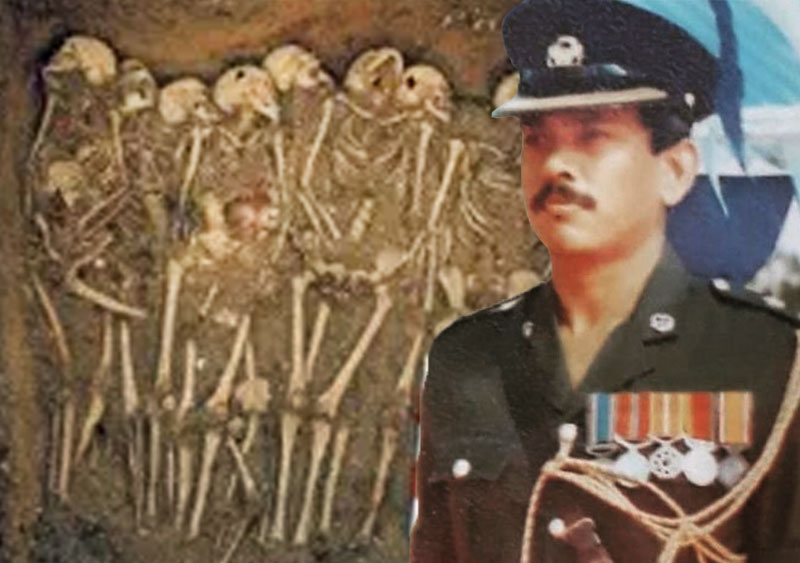
In the published version, individual names were redacted but this was about the area where the future defence secretary and president Gotabaya Rajapaksa led the military.

Lieutenant colonel Rajapaksa was the coordinating officer of Matale in the period in question, during which more than 700 persons had reportedly gone missing.

Relaunch investigations – Rights activist

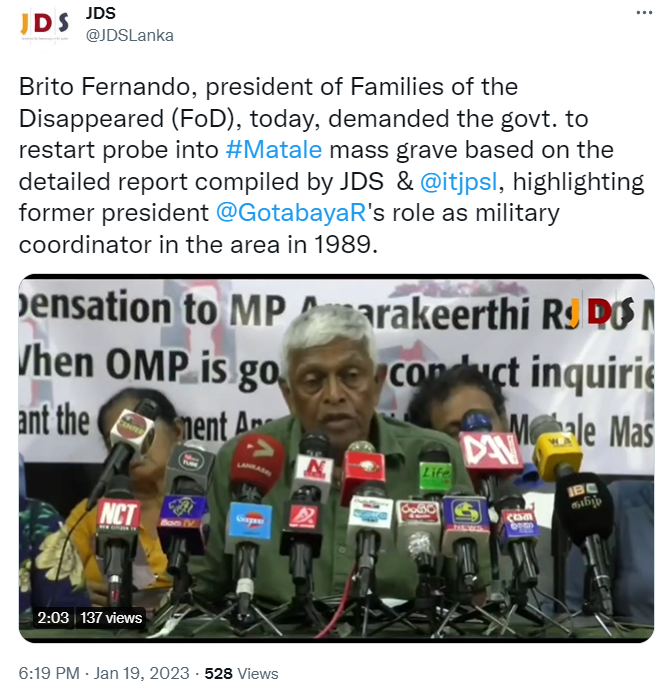
Meanwhile, head of an association of families of the disappeared, Britto Fernando, has demanded the government restart the probe into the Matale mass grave, based on a detailed report compiled by Journalists for Democracy – Sri Lanka and ITJPSL.

That report too, has highlighted Gotabaya Rajapaksa’s role and military coordinator in the area in 1989.