48th session of UNHRC to commence tomorrow

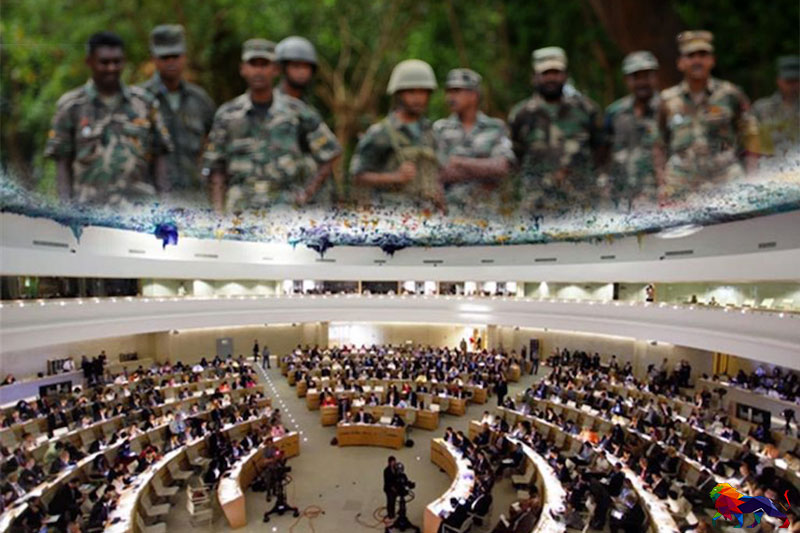
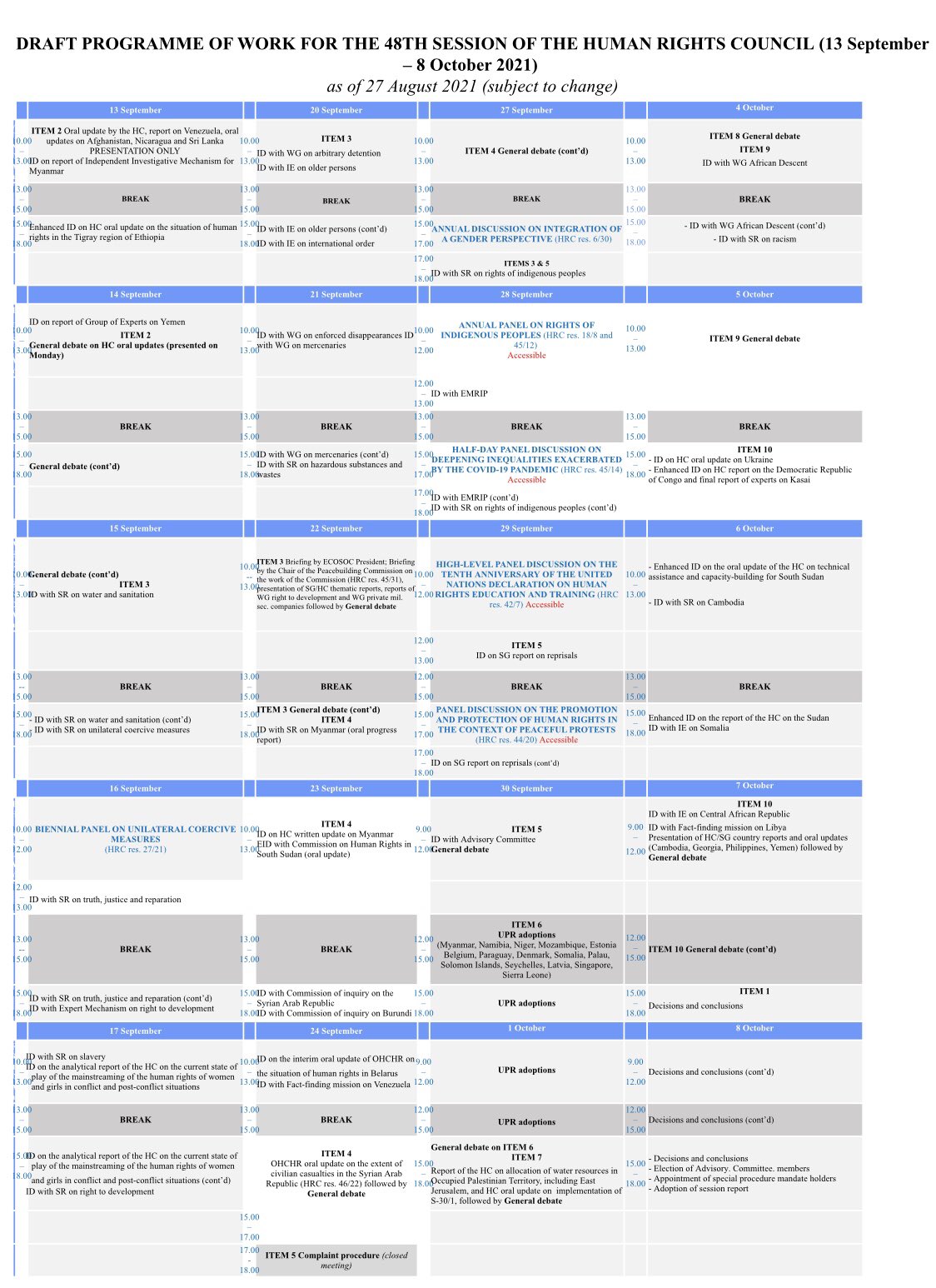
The 48th session of the United Nations Human Rights Council is set to commence in Geneva tomorrow (13).

The High Commissioner for Human Rights’ oral report on Sri Lanka will be presented tomorrow as well.

The 48th session of the United Nations Human Rights Council will be held in Geneva, Switzerland from 13 September until 08 October.

The UN High Commissioner for Human Rights Michelle Bachelet will be presenting the oral report on the progress made by Sri Lanka after a resolution on accountability of Sri Lanka for reconciliation and the promotion of human rights was passed at the previous session of the Human Rights Council last year.

Posted in Uncategorized

Daily COVID cases count climbs to 2,642

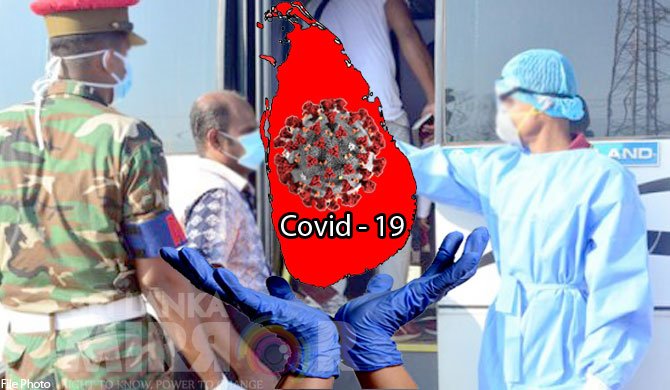
The Epidemiology Unit of the Health Ministry reported that 620 more people were tested positive for COVID-19 in Sri Lanka today (Sep. 12), moving the daily total of new cases to 2,642.

According to the Government Information Department, 2,641 of them have been associated with the New Year Cluster and the remaining one was identified as returnees from overseas.

This brings the tally of coronavirus infections confirmed in the country to 485,922.

Official data showed that more than 61,800 active cases are currently under medical care at hospitals, treatment centres and homes.

Total recoveries from the virus infection reached 412,812 earlier today as 1,579 more patients were discharged from medical care upon returning to health.

Meanwhile, Sri Lanka registered 144 new COVID-related fatalities confirmed by the Director-General of Health Services on Sep. 11. The new development pushed the official death toll from the virus outbreak in Sri Lanka to 11,296.

Turmoil as new forex decisions rattle markets

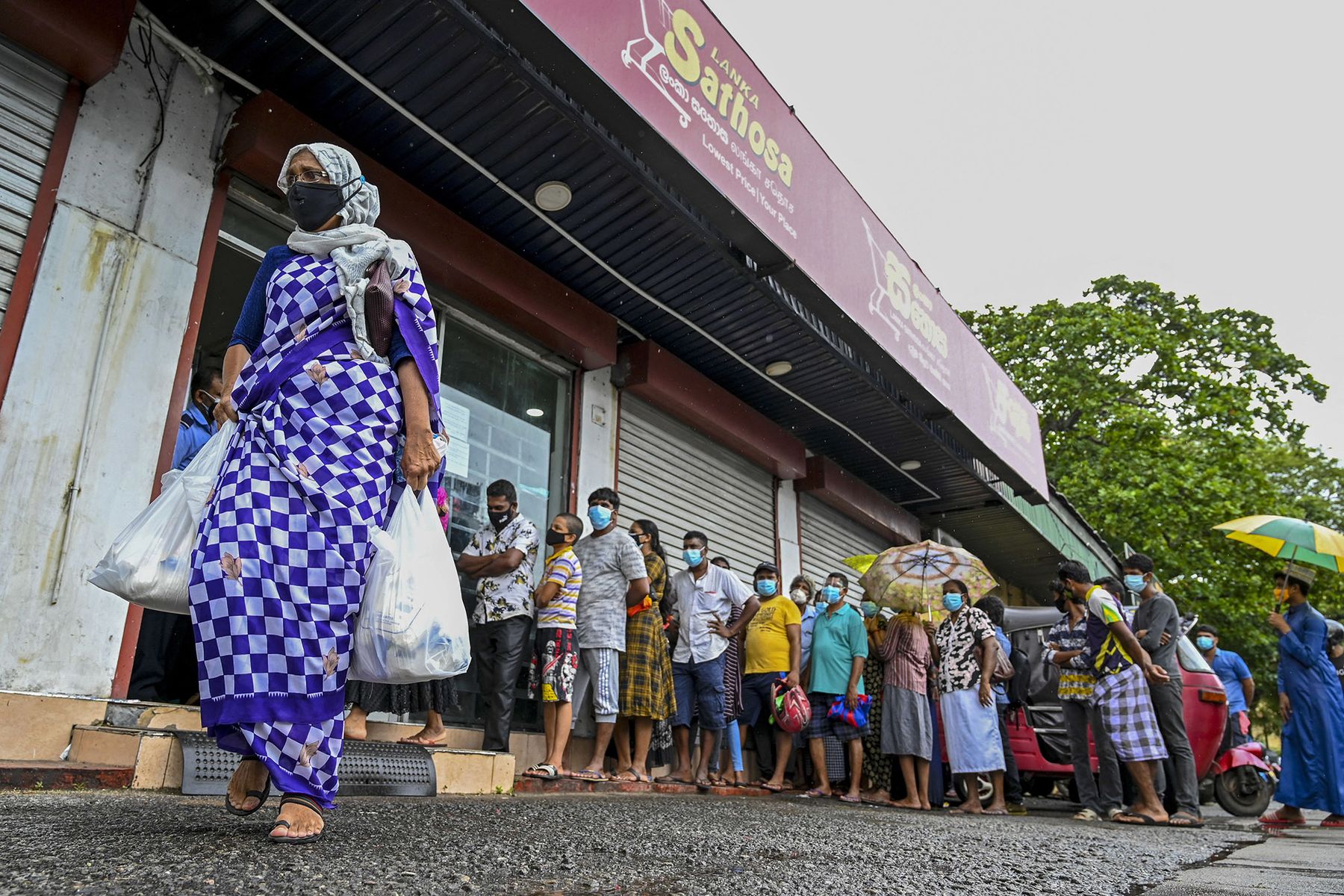
A flurry of decisions this week by the Central Bank (CB) on the use of foreign exchange and further restricting imports have rattled the money markets and triggered concerns of shortages in some imported food items, mobile phones and household appliances.

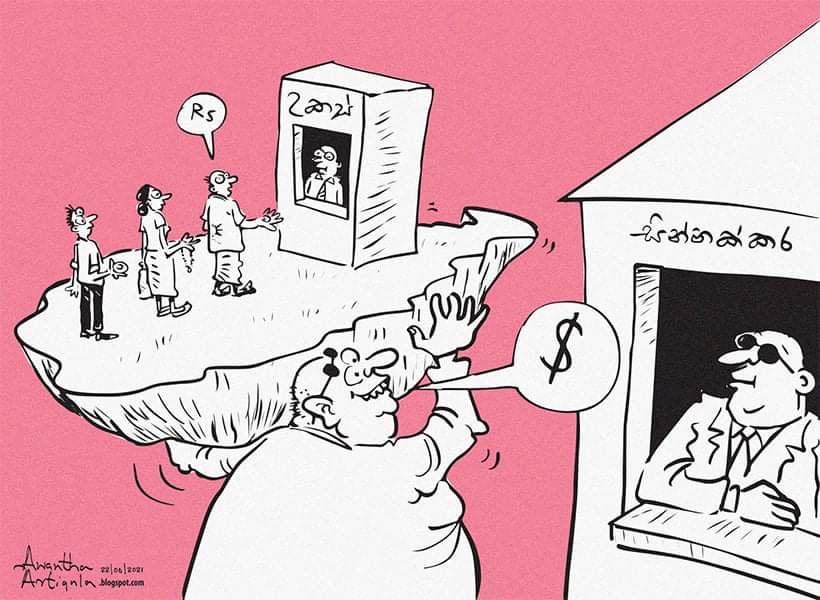
On Tuesday, the CB issued a directive to banks to stick to the CB’s daily rate of Rs.202-203 per dollar and desist from the bank-to-bank rate of Rs.210-220 which has depreciated the rupee sharply – with the move leading to confusion and exporters holding onto their dollars. Adding to the problems, the CB on Thursday introduced measures to curb imports by enforcing a 100 percent cash deposit margin on importers when opening LCs.

“This could lead to shortages as it’s difficult to provide a cash deposit against letters of credit,” one importer said. The CB also directed banks not to advance money to importers to meet the cash deposit margin. Other importers said that small importers cannot afford to block their money in LC margins and they would have to stop imports or resort to smuggling.

The total import cost of the items under the new regulations was US$871 million in 2020 and $1 billion in 2019. The import cost of these items from January to July 2021 was $753 million, Finance Ministry data showed.

The uncertainty came as former CB Governor and current State Minister for Finance Ajith Nivard Cabraal prepared to take over as the Governor, his third term in office, on September 16. Informed sources said that a Cabinet paper providing him cabinet rank status was likely to be presented at Monday’s Cabinet meeting. Prof. W.D. Lakshman at a news briefing on Friday at 3 pm announced that he was stepping down from September 14.

The changes at the CB comes after which analysts said were a series of bad decisions which culminated in a last-ditch attempt to saving dollar reserves when the Governor admonished the banks to maintain the US dollar exchange at a certain rate. In the meantime, the commercial banks planned to meet the Governor (if Mr. Cabraal has already been appointed) next week seeking a revocation of the ‘arm-twisting’ directive.

Tuesday’s move created an impasse in transactions between banks and importers with banks refusing to honour their letters of credit, a banker said. The banks have requested delayed payments from importers slapping a currency exchange risk on the latter further aggravating their issues. Money market dealers said import bills were being largely financed through remittances by migrant workers.

Banking sources said that two banks are following the CB request, but others have adopted a wait-and-see approach. However foreign banks are not heeding the regulator’s request, they said. “According to the governance structure, foreign banks cannot oblige ‘letters’ sent by anyone except if it binds them legally. So, they are not adhering to the Governor’s request,” a source told the Business Times. This will bring about a cartel situation for foreign banks, he said noting that this needs to be addressed as soon as possible,

There is a fair amount of private sector commercial transactions pending, a second banker noted. “There are unsettled oil bills, engine payments of large aircrafts and large food imports need to be settled.”

Adding to the problems a West Asian manufacturer exporting large food items to Sri Lanka through a government importer has refused to transact on credit in the future. “This manufacturer based in West Asia has told the government importer that goods will be shipped solely on cash and not on credit,” an importer in the industry said. He added that most intermediary goods like fabric, packaging, industrial chemicals, clinker for cement etc are delayed affecting some of the exports as well.

Meanwhile, export proceeds of a few million dollars are sitting in government banks without the exporters converting them into rupees, a third banker told the Business Times. Banks are fuming as they stand to lose Rs. 100 to 200 million a month if they buy and sell dollars at the CB stipulated rate.

The biggest dilemma facing the banks is honouring the already committed LCs. “A central bank has to give us a payment plan without which we have no option but to default payment,” a fourth banker pointed out. This will further bring down the credit rating in the country. Economists say that on the one side there is a food crisis and a fiscal crisis on the other – both creating a black market in the months to come. “A lot of under-invoicing will happen by exporters if the CB forces banks to maintain the dollar at the ceiling of Rs. 203,” an economist said.

Items affected by the import restrictions include mobile phones and fixed phones, home appliances such as fans, TVs, refrigerators, washing machines and digital cameras, clothing and accessories, household and furniture items, air conditioners, fruits such as fresh apples, grapes and oranges, cosmetics and toiletries, beverages such as beer and wine, other food and beverages such as cereal preparations, starches, chocolates, cheese and butter, and other non-food consumables such as musical instruments, tobacco products, toys and stationery.

Drafting of new constitution: Final draft in November

The expert committee appointed to draft a new constitution has sought a three-month extension to submit the final draft to President Gotabaya Rajapaksa while an initial draft is being studied by the Legal Draftsman’s Department, The Sunday Morning learnt.

Responding to a query by The Sunday Morning, Presidential Secretariat Director General – Legal Affairs Harigupta Rohanadeera confirmed that a request was made by the committee and that it was granted.

The extension gives the committee till December to submit a final draft.

Sources close to the committee said the extension was requested due to delays caused by the prevailing Covid-19 situation in the country.

The committee is chaired by Romesh de Silva PC and includes Gamini Marapana PC, Manohara De Silva PC, Sanjeewa Jayawardena PC, Samantha Ratwatte PC, Prof. Naazima Kamardeen, Dr. A. Sarveswaran, Prof. Wasantha Seneviratne, and Prof. G.H. Peiris. The nine-member committee to draft a new constitution was approved by the Cabinet in September last year.

When contacted on the matter, Minister of Justice Ali Sabry expressed confidence that the committee will have a final draft ready by the end of November.

President Rajapaksa pledged to replace the 1978 Constitution with a new one. The appointment of the expert committee is the first step in several processes that would be required to draft a new constitution for Sri Lanka.

Several members of the Government, including some senior politicians, had called for the abolition of the provincial council (PC) system and the 13th Amendment to the Constitution. The call for the removal of the legislation prompted Indian authorities to reaffirm their stance that the 13th Amendment to the Constitution should remain.

The Tamil National Alliance (TNA) criticised the postponement of a planned meeting in June with the President to discuss constitutional reforms. The TNA had submitted proposals for constitutional reforms to the President last year, and the expert committee.

Posted in Uncategorized

Sri Lanka Is Running Out of Money for Imports as Delta Rages – Bloomberg

Sri Lanka’s dwindling foreign exchange reserves risk spiraling into a crisis that could force the South Asian nation to tighten policy more aggressively and seek an International Monetary Fund bailout.

After meeting a $1 billion debt repayment in July from reserves, the government had only enough dollars to cover less than two months of imports. The nation buys wheat, sugar and milk powder from abroad and, with the Sri Lankan rupee down 7.3% this year, the import bill is soaring, stoking inflation and raising concerns about panic buying and hoarding.

“For investors it’s a question of when, not if, they run out of FX reserves,” said Nivedita Sunil, senior analyst for Emerging Markets at Lombard Odier in Singapore. “If you see where the bonds are trading, they are clearly telling you that they are no longer taking a longer term view.”

Sri Lanka’s foreign exchange reserves rose 26% to $3.55 billion last month, after the nation converted the IMF’s special drawing rights, which the South Asian island nation received on Aug. 23, into U.S. dollars, the central bank said in a publication on Friday.

While authorities maintain they will repay $1.5 billion of foreign bond payments due in January and July, a Bloomberg gauge of one-year default probability has risen almost 20 percentage points, to Asia’s highest level at about 28%.

Government revenue is far short of its target as pandemic curbs hurt economic activity, Finance Minister Basil Rajapaksa told parliament on Sept. 7. With a third wave of Covid-19 running across the island, the administration has taken increasingly draconian measures to deal with the crisis, from declaring a state of emergency to seizing rice stocks from private mills. Policy makers have extended lockdowns, raised interest rates, restricted imports and asked banks to offer foreign currency loans. Central bank Governor Weligamage Don Lakshman will step down Sept. 14.

The IMF has not received a request for financial support from Sri Lanka, Masahiro Nozaki, the mission chief for Sri Lanka, said in an email. “We stand ready to discuss options if requested. We continue to closely monitor economic and policy developments in Sri Lanka.”

The emergency measures are necessary “to give legal backing to stop hoarding. But with emergency and sudden lockdowns comes rumors and panic, and that creates excess buying,” said Adrian Perera, chief executive officer of Lanka Rating Agency. “Rates will need to be raised again this year to keep inflation under control and support the rupee.”

Tourism Hit

Travel restrictions have hammered the tourism industry, which contributes about 5% of the total economy, while an extended lockdown to try to halt the spread of the delta variant has hurt commerce and industry.

Among President Gotabaya Rajapaksa’s emergency measures passed by parliament this week was the appointment of Major General N.D.S.P. Niwunhella as commissioner of general and essential services, giving him the power to commandeer food supplies and regulate prices to “safeguard the interest of consumers.”

Opposition lawmakers decried the move as an attempt to extend the president’s power, arguing that the crisis could be dealt with through existing legislation.

The emergency rules allow the president “to suspend civil liberties, arrest and detain any citizen without a court order, suspend laws of the country, enter any premise without a court order and seize privately owned property,” lawmaker Eran Wickramaratne for the main opposition Samagi Jana Balawegaya party said in parliament. “No President should be given more powers than are needed to execute his responsibilities.”

The new rules were enacted swiftly. On Wednesday, officials seized stocks of rice from mills in Polonnaruwa district, one of the nation’s main growing regions, in order to distribute the grain under a government price-control system, according to the government. Authorities accused the mills of hoarding the supplies.

The following day, the government introduced a 100% cash margin for letters of credit on imports of 693 items, including chocolates, dairy products, wines, cosmetics, clothes, and electronic goods, and barred banks from extending credit to buyers to meet the cash requirement.

Bank Loans

The measures come on top of capital controls imposed earlier this year to limit how much foreign currency leaves the country. To shore up reserves, the government has also asked banks and institutional investors to propose foreign-currency term loans by Sept. 22, in multiples of $50 million.

The swapline with China and another with Bangladesh, together with funds supplied in August by the IMF through special drawing rights — a facility offered by the fund to boost global liquidity — should cover Sri Lanka’s dollar requirements until year-end at least and enable it to meet bond repayments due in January, according to Ek Pon Tay, senior portfolio manager at BNP Paribas Asset Management in Singapore. But in the “medium term, firm energy prices and the pandemic’s impact on tourism earnings pose challenges to replenishing foreign-exchange reserves.”

A total $3.6 billion of foreign debt matures in 2022 for Sri Lanka, Fitch Solutions calculates.

With currency reserves depleted and inflation now at 6% — the upper end of the central bank’s target range — investors are bracing for more rate increases. The central bank on Aug. 19 unexpectedly raised its benchmark rate for the first time since late 2018, saying lower credit costs had boosted imports more than exports, widening the trade deficit.

The rate hike helped Sri Lanka’s dollar notes erase monthly losses and gain 2.9% in August, the biggest increase across Asia, according to a Bloomberg index. But it may not be enough.

Fitch Solutions forecasts the central bank will raise rates by another 50 basis points this year, but that won’t solve Sri Lanka’s structural challenges as businesses are aware of the dollar shortage. S&P Global Ratings last month cut the outlook to negative on Sri Lanka’s CCC+ junk rating, citing concern that attempts to boost reserves may fall short.

Sunil at Lombard Odier says the government needs a longer-term solution. “In our view, that can’t happen without an IMF program.”

— With assistance by Lilian Karunungan, Ronojoy Mazumdar, Eric Martin, Asantha Sirimanne, and Ragini Saxena

(Updates with FX reserves data and IMF comments from fourth paragraph.)

Posted in Uncategorized

Stop leasing port property, trade unions write to the President

Port Trade Unions have requested the President to terminate the Cabinet Paper on the South Asian Freight Service Supply Centre, which proposes to release 13 acres of the Sri Lanka Ports Authority for a Chinese investment.

In a letter to the President, the All Ceylon Ports General Employees Union said lands which are required for the strategic development of the Colombo Port should not be released under any circumstance.

It has been proposed to hand over 13 acres of land bordering the Colombo Port City, CICT, SAGT and the access road to the Western Terminal to the Chinese majority shareholder CICT.

This proposal has been submitted as a joint venture project to develop the Port of Colombo as South Asian Freight Service Supply Centre.

The All Ceylon Ports General Employees Union points out that 70 percent of the services provided by the Ports Authority will be lost annually due to the implementation of this project.

They emphasize that this land, which is being prepared for sale for a period of 35 years, is at a strategically important point in the future development of the Colombo Port.

COVID Death Toll in Sri Lanka passes 11,000 mark

A total of 157 more COVID-19 related deaths that occurred yesterday (09) were confirmed by the Director-General of Health Services today pushing the death toll to 11,152.

According to the Government Information Department, 87 females and 70 males are among the deceased.

A total of 130 people who are above 60 years of age are among the deceased while 23 of them are between 30 and 59 years of age.

Four deaths have been reported below 30 years of age.

Posted in Uncategorized

Sri Lanka’s Opposition Leader calls on Rajapaksa Govt to resign immediately

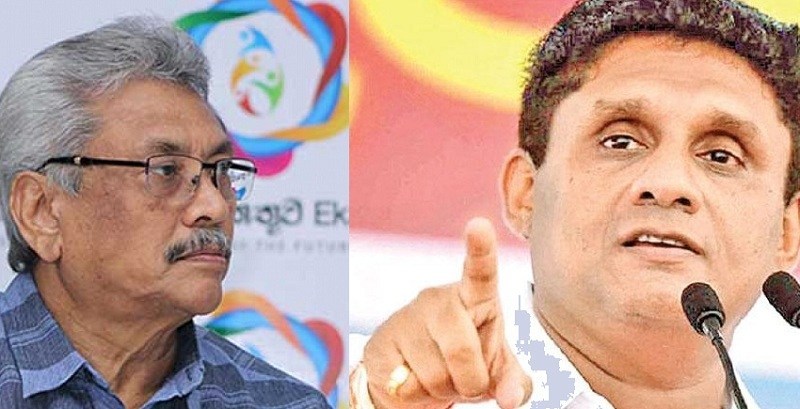
Sri Lanka’s Opposition Leader Sajith Premadasa called on the countries Government to step down immediately and call an election so that the people might decide who should lead the country out of what he called the present crisis.

He said he and the opposition was ready to lead the nation out of what was an “interminable crisis” that the current government was wholly unable to manage.

The Leader of the Opposition said that the government’s reckless, inefficient and unskilled nature is proven day by day in its activities and the only thing actually happening is the change of heads.

The Leader of the Opposition said the present government has no ability to lead the country out bankruptcy.

Lankan Tamil leaders pay homage to Bharathiyar on his 100 th. death anniversary

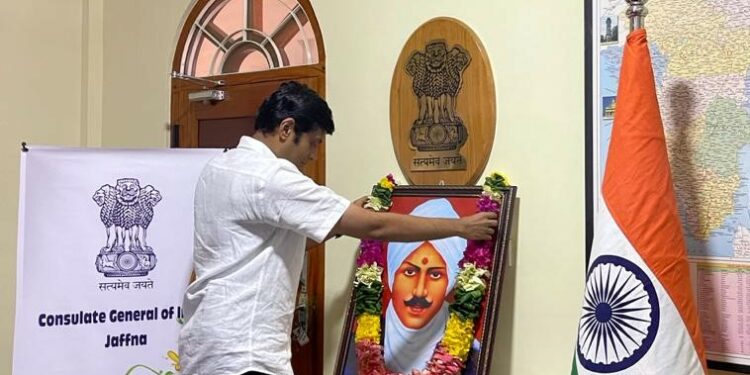
The Consulate General of India in Jaffna, observed the 100 th. death anniversary of India’s National Poet Subramaniya Bharathiar on Saturday 11 September.

Consul General Raakesh Natraj Jayabhaskaran garlanded & offered floral tribute to the “Mahakavi” at the Consulate & India House. Sri Lankan Minister of Fisheries Douglas Devananda, Members of Parliament Angajan Ramanathan, Dr. Suren Raghavan,ITAK M. A. Sumanthiran,TELO Leader Selvam Adaikkalanathan,PLOTE Leader Dharmalingam Siddharthan, S. Sritharan,TPA Leader C. V. Wigneswaran, former Speaker of the Northern Provincial Council C. V. K. Sivagnanam, Jaffna Mayor His Worship V. Mannivannan, former Members of Parliament EPRLF Leader Suresh Premachandran & M. K. Sivajilingam, former Head of the Department of Tamil, Jaffna University Prof S. Sivalingarajah, paid their tributes to the Mahakavi through video or audio messages.

Posted in Uncategorized

Rajapaksa’s experiment with organic farming in Sri Lanka a warning to developing countries

An influential section of Sri Lankan agricultural economists and scientists has deplored the recent course change in the country’s agricultural policy made by the Gotabaya Rajapaksa government. The decision by the government to ban the use and import of chemical fertilisers and pesticides in pursuit of a “100 per cent organic food producer” status for Sri Lanka has already had disastrous consequences for the economy of the island nation, the Sri Lanka Agricultural Economics Association (SAEA) warned in a letter to President Rajapaksa on May 25, 2021. It pointed to the adverse effects of the policy on “food security, farm incomes, foreign exchange earnings and rural poverty.”

President Rajapaksa’s ill-conceived and extremist policy, announced in April this year, of banning the import of all chemical fertilisers and pesticides as a way of promoting organic farming, is threatening to plunge the country’s agriculture into a deep production slump. As a consequence, the export of tea, Sri Lanka’s primary agricultural export, and of other commodities are projected to decline. The economy appears set for a fall in foreign exchange earnings in the midst of the Covid-19 pandemic.

The SAEA letter provided the following detailed estimates of the potential economic loss to farmers due to the policy:

When converting from conventional agriculture into organic farming, the Government should weigh the technological, environmental, and economic costs and benefits. The preliminary findings of the studies conducted by the SAEA on potential economic losses of the import ban and respective estimations are given below for your consideration.

(a) Agronomic studies reveal that the average yields from paddy can drop by 25 per cent if chemical fertilisers are fully replaced by organic fertilisers. This loss in productivity could reduce the profitability of paddy farming by 33 per cent and rice consumption by 27 per cent if paddy is cultivated just with organic fertilisers with a complete ban on rice imports. In contrast, applying organic fertiliser with the recommended dosages of chemical fertilisers would improve the profitability of farming by 16 per cent.

(b) Absence of chemical fertiliser would drastically reduce the productivity of the Vegetatively Propagated Tea (VPT). With a 35 per cent productivity drop, the export volume of tea would go down from 279 to 181 million kg, causing an income loss of Rs. 84 billion. The estate sector will likely incur significant losses compared to those of tea smallholders. These losses could further be aggravated due to increased cost of labour to apply bulky organic fertilisers.

(c) The coconut yields would go down by 30 per cent if chemical fertilisers and pesticides are not applied. This situation will adversely impact fresh coconut availability for the production of coconut oil, desiccated coconut and other coconut products. The loss in foreign exchange earnings can be as high as Rs. 18 billion, based on the assumption that only 26 per cent of the total coconut extent is fertilised. When the additional cost for the importation of edible oils is considered, the loss of foreign exchange earnings will be even higher.

(d) The above results were derived considering the immediate effects on three agricultural sub-sectors. An analysis performed accommodating adjustments in the economy over the medium to long run reveals that a reduction in average agricultural productivity by 20 per cent could cause a decrease in Gross Domestic Product (GDP) by 3.05 per cent suggesting an overall contraction of the economy with the implementation of the import ban. (emphases added)

The letter requested the President to “substitute the import ban on chemical fertilisers and pesticides with the set of alternative measures” that included making scientifically validated Good Agricultural Practices (GAP) as a mandatory national standard and disincentivising overuse of chemicals in agriculture through an appropriate mix of legal standards, taxes, subsidies and output price support. The letter also asked for the strengthening of agricultural extension to “improve awareness of the safe use of chemical fertilisers and pesticides”.

On coming to office in 2019, President Rajapaksa promised subsidised imported fertilisers to farmers. Yet in a matter of just two years, the Sri Lankan cabinet approved Rajapaksa’s proposal to completely ban the import of inorganic fertilisers and all synthetic agro-chemicals — effectively, the imports of all chemical fertilisers, pesticides, fungicides and weedicides. A gazette notification on May 6, 2021 brought this into immediate effect. For any shipment after 6th May 2021, permissions for unloading were cancelled, and banks told not to issue Letters of Credit on the import of banned substances.

What caused this about-turn?

The two factors behind the change in policy direction, according to news reports, are first, Sri Lanka’s foreign exchange crisis, and second, the rise in food prices owing to the lockdowns and other disruptions induced by Covid-19. It is estimated that Sri Lanka spends about US$ 400 million on fertiliser imports annually. A ban on chemical fertilisers, it was thought, would reduce the pressures on foreign exchange. Added to this was the pressure from President Rajapaksa’s group of advisors that included a medical doctor, who reportedly convinced him that the use of chemicals in agriculture was leading to the spread of chronic kidney disease. Sri Lankan scientists have in fact argued that there are no links between the use of chemicals as farm inputs and kidney disease. They attributed the rise in kidney diseases to “hard water in conjunction with fluoride present in many wells” (for a short review, see here). But these voices of reason were disregarded, and the organic farming lobby pushed the policy through.

On May 10 2021, the “Presidential Task Force on Creating a Green Sri Lanka with Sustainable Solutions to Climate Change” was formed under President Rajapaksa’s Chairpersonship. The Task Force was authorised to implement the import ban and submit a plan to create a “Green Sri Lanka”. Initially, the Task Force had 46 members, but later the number of members was reduced to 25 with Mahinda Amaraweera as the Chairperson. Many senior agricultural scientists were excluded from its membership, and it appears that it was filled with people with questionable scientific credentials. One member of this task force, for example, had once claimed to have identified a self-generating rice variety of yore that had fed the ten giant warriors of the Sinhala King Dutugemunu of the Anuradhapura Kingdom between 205 BC to 161 BC. Agricultural scientists tested the claim and found that the claimed variety was of sorghum and not of rice at all! Yet another member had claimed that glyphosate even dissolved reservoir bunds! Such was the state of scientific rigour within the Task Force.

A decision was also taken to import large quantities of compost, as well as boost the domestic production of compost, to substitute for chemical fertilisers. It is well-known that compost can hardly be classed as “organic” as it contains many potentially toxic trace elements, a fact that, alas, has never persuaded the soldiers of organic agriculture to stop promoting it as an alternative to chemical fertilizers.

It is not just the SAEA that sounded the alarm over the outcome of the new policy. Growers of tea, which is the most severely affected crop in the present crisis followed by rice, pepper and cinnamon, are very worried. Herman Gunaratne, a master tea maker from Ahangama and a member of Task Force himself, says that Sri Lanka’s tea production of 300,000 tonnes may be halved due to the organic farming policy. Given that 10 per cent of Sri Lanka’s export incomes come from tea, this presents a serious potential problem. In an interview to the South China Morning Post, he said:

The ban has drawn the tea industry into complete disarray … The consequences for the country are unimaginable … The tea industry depends on nitrogen (N), phosphorus (P) and potash (K) … Mainly it is the nitrogen component that we cannot do without. Without it, you can expect the decline in production by as much as 50 per cent … I cannot subscribe to the view that it [i.e., going organic] helps the tea quality except for the fact that if we go completely organic, we will lose 50 per cent of the crop. [But] we are not going to get 50 per cent higher prices … And there is an extremely limited market for organic tea in the world. There is no way in which it can compensate for the decline in the crop.

Sensing trouble and responding to widespread protests from farmers and growers, the Rajapaksa government reversed some aspects of the policy by the end of May 2021. On 31st May 2021, the Cabinet approved the “import of carbonic fertilisers, natural minerals and chelated herbal trace minerals”. A tender was also floated to import organic fertilisers with a minimum of 10 per cent nitrogen, even though such a product is not known to exist outside blood meal, which contains about 13.25 per cent nitrogen. On 31st July 2021, some fertiliser mixtures were permitted to be imported by the “protected agriculture sector”. However, no detailed guidelines exist for the orders issued above, and much confusion exists on what can be imported and what cannot. A list of 25 agrochemicals were recommended for imports for emergency use by agricultural scientists, but this recommendation was rejected by the government. To top it all, even the import of compost was banned after officials raised questions about the violation of the regulations pertaining to plant and animal quarantine.

The muddled and unscientific policy has caused damage in other sectors as well. For instance, 20,000 out of 107,000 hectares of rubber in Sri Lanka are affected by Pestalotiopsis, a fungal leaf disease that is controlled by Carbendazim and Hexaconazole application through spraying. Further, chemical fertilisers need to be applied to promote better leaf growth. Neither are available in the market. As a result, the Colombo Rubber Traders Association expects rubber production to drop by 15-20 per cent. According to the Association, “This leaf disease is possibly best described as the equivalent of Covid-19 in the case of the rubber industry, considering both its devastation and the rapid speed at which it is spreading.”

The havoc caused by the Sri Lankan experiment with organic farming is a warning to developing countries across the world against falling into a similar trap. The irrational reduction in chemical inputs to agriculture even at low levels of productivity can spell disaster. Take a country like India where soils are generally poor in organic matter content. An estimated 59 per cent of soils are low in available nitrogen, about 49 per cent in available phosphorus, and about 48 per cent in available potassium. Indian soils are also deficient in varying degrees in micronutrients such as zinc, iron, manganese, copper, molybdenum and boron. Micronutrient deficiencies are not just yield-limiting in themselves; they also disallow the full expression of other nutrients in the soil, leading to an overall decline in fertility.

Agricultural scientists have always been aware of the nutrient deficiencies of soil, as well as the perils of overuse of chemicals and the improper/imbalanced application of fertilisers. They therefore recommend location-specific solutions to nurture soil health and sustain increases in soil fertility. They suggest soil-test-based location-specific balanced fertilisation and integrated nutrient management methods combining organic manures (i.e., farmyard manure, compost, crop residues, biofertilisers, green manure) with chemical fertilisers. Thus, while they may advocate reducing the use of chemical fertilisers in some locations, they would promote its use in others.

Such a comprehensive and integrated approach requires a firm adherence to science and the scientific method, and an equally firm rejection of anti-science models dressed up as “organic,” “eco-friendly,” “pro-nature” and so on. President Rajapaksa’s policy falls squarely into the latter category, much like the promotion of Zero Budget Natural Farming (ZBNF) by the present Government of India. Only the total withdrawal of this policy can save Sri Lankan agriculture. The Sri Lankan government would do well to listen to the country’s agricultural scientists and not to quacks masquerading as experts.

R. Ramakumar is NABARD Chair Professor, School of Development Studies, Tata Institute of Social Sciences, Mumbai. Views are personal.

The article originally appeared on the Foundation for Agrarian Studies website. It has been published with permission.

Source:The Print